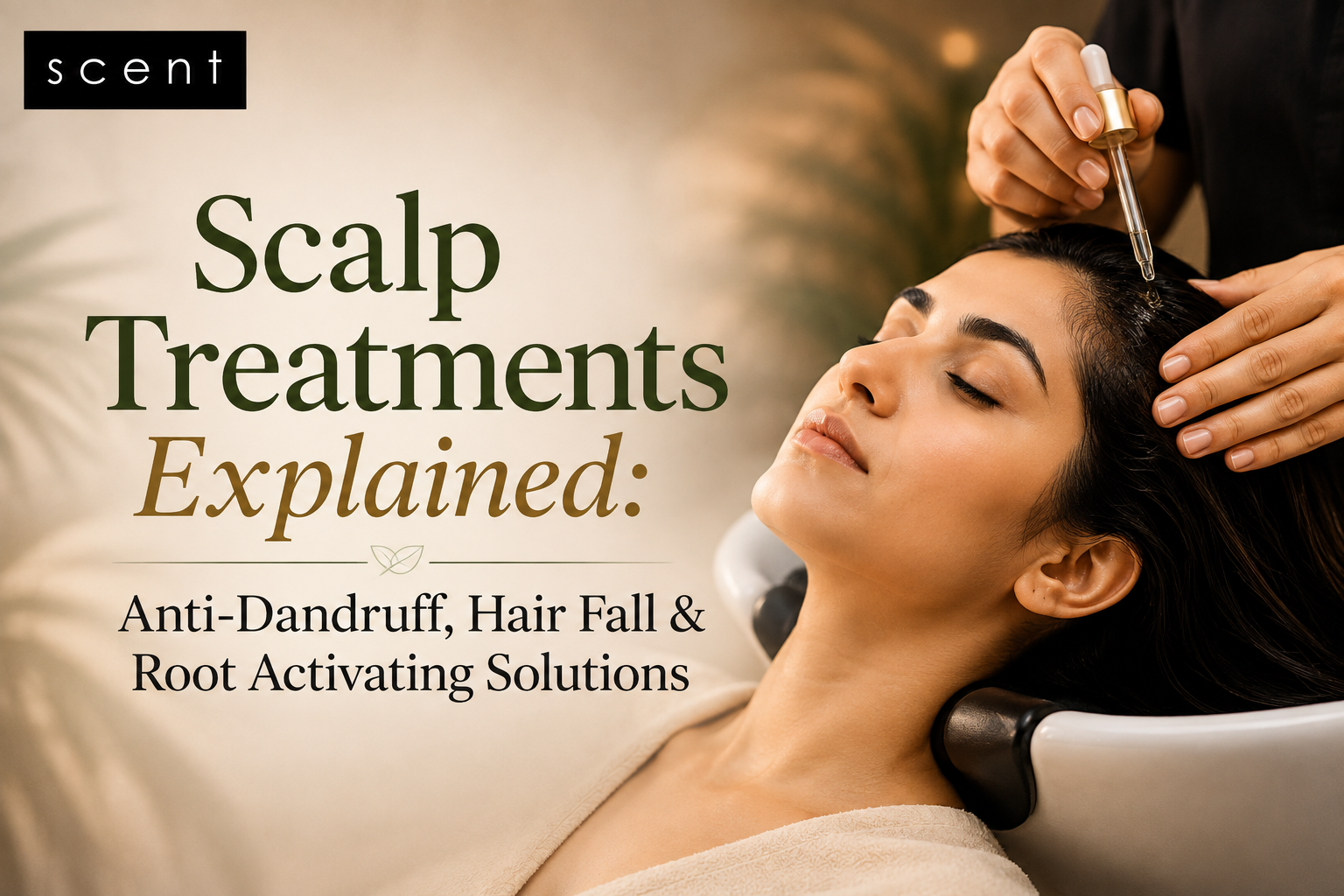
Scalp treatments are targeted salon or clinical procedures — using scrubs, serums, and active ingredients — that address a specific scalp problem: flaking (anti-dandruff), excess shedding (hair fall control), or weak follicles (root activation). The right treatment depends on your specific symptom, not on your hair type alone, so identifying the root cause is the first step before booking any session.
Table of Contents
- What Is a Scalp Treatment and Why Does It Matter?
- What Causes Dandruff and How Do Anti-Dandruff Treatments Work?
- What Causes Hair Fall and Can Scalp Treatments Help?
- What Are Root-Activating Treatments and How Do They Work?
- Which Scalp Treatment Is Right for You?
- How Often Should You Get a Scalp Treatment?
- What Happens During a Professional Scalp Treatment Session?
- Where to Get the Best Scalp Treatments in Bangalore?
- FAQs
What Is a Scalp Treatment and Why Does It Matter?
A scalp treatment is a focused procedure designed to restore the scalp’s health rather than just the hair strand. Most hair problems — flaking, thinning, dullness, slow growth — actually originate at the scalp level, not in the hair shaft itself. Dermatologists generally treat the scalp as an extension of facial skin, meaning it needs its own exfoliation, hydration, and microbiome balance, just like your face does.
Scalp treatments typically fall into three categories:
- Anti-dandruff scalp treatments – target flaking, itching, and oil-fungus imbalance
- Hair fall treatments – reduce excess shedding and strengthen the hair growth cycle
- Root-activating treatments – stimulate follicles for thicker, denser regrowth
A scalp spa treatment at a salon usually combines two or more of these depending on what your scalp analysis shows.
What Causes Dandruff and How Do Anti-Dandruff Treatments Work?
Dandruff is caused by a combination of excess sebum (oil), a naturally occurring fungus called Malassezia, and individual sensitivity to that fungus — not by poor hygiene. Dandruff affects more than 50% of the global population, making it one of the most common scalp conditions worldwide, and it tends to peak between the ages of 20 and 50 and is slightly more common in men.
An anti-dandruff treatment for scalp care works in three stages:
- Exfoliation – a scalp scrub or scaling treatment lifts dead skin cells and product buildup
- Anti-fungal action – active ingredients like zinc pyrithione, salicylic acid, or ketoconazole reduce Malassezia overgrowth
- Barrier repair – serums with soothing agents (tea tree, niacinamide) calm redness and itching
A clinical study on a scalp scrub-and-serum regimen recorded that fine dandruff incidence dropped from 6.9% at baseline to 0% by day 15, and scalp hydration improved by over 76% within the same period. This shows visible dandruff reduction is realistic within 2 weeks of consistent treatment, not months.
Which one is better for sensitive skin?
For a sensitive or reactive scalp, mild anti-fungal treatments (low-concentration salicylic acid, aloe-based serums) are safer starting points than strong chemical scaling treatments, which can trigger irritation if overused.
What Causes Hair Fall and Can Scalp Treatments Help?
Some daily hair shedding is completely normal. Dermatologists at the American Academy of Dermatology state that it’s normal to shed between 50 and 100 hairs a day as part of the natural growth cycle. Hair fall becomes a concern when shedding consistently exceeds this range, or when you notice thinning at the crown, a widening parting, or visible scalp patches.
A hair fall treatment at a scalp level typically addresses:
- Poor blood circulation to follicles (from stress, tight hairstyles, or scalp tension)
- Nutrient deficiency at the root (iron, biotin, protein)
- Clogged follicles from oil, sweat, or styling product buildup
- Hormonal or seasonal shedding cycles
Hair fall control treatment sessions usually combine a deep scalp massage to boost microcirculation, a nutrient-infused serum applied to the roots, and sometimes low-level light or micro-current tools. These sessions don’t reverse genetic (pattern) hair loss, but they can meaningfully reduce shedding caused by scalp-level buildup, stress, or nutrient gaps.
What Are Root-Activating Treatments and How Do They Work?
A root activating treatment focuses on waking up dormant or weakened follicles rather than just reducing shedding. These treatments suit people noticing thinning density (not bald patches) or slower regrowth after a shedding phase.
Root-activating treatments generally use:
- Peptide or caffeine-based serums to stimulate the follicle’s growth phase
- Micro-needling or derma-roller techniques to trigger a mild repair response that boosts absorption
- Scalp massage with warm oils to improve nutrient delivery to the root
- LED or laser caps in advanced clinical setups, used to stimulate cellular activity at the follicle
Unlike anti-dandruff or hair fall treatments, root activation is a preventive and density-building treatment — it’s most effective when started early, before follicles have fully miniaturized.
Which Scalp Treatment Is Right for You?
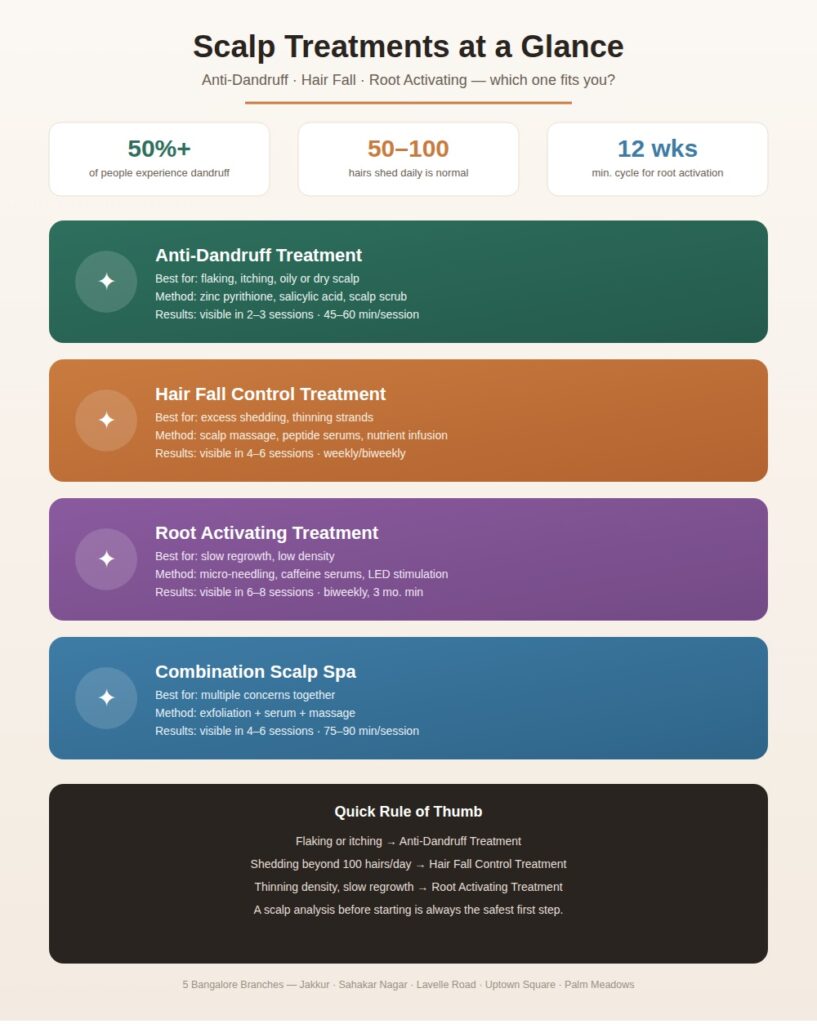
| Treatment Type | Best For | Key Ingredients/Methods | Typical Session Time | Visible Results In |
|---|---|---|---|---|
| Anti-dandruff scalp treatment | Flaking, itching, oily/dry scalp | Zinc pyrithione, salicylic acid, tea tree, scalp scrub | 45–60 min | 2–3 sessions |
| Hair fall control treatment | Excess shedding, thinning strands | Scalp massage, peptide serums, nutrient infusion | 45–60 min | 4–6 sessions |
| Root activating treatment | Slow regrowth, low density | Micro-needling, caffeine serums, LED stimulation | 60–75 min | 6–8 sessions |
| Combination scalp spa treatment | Multiple concerns together | Exfoliation + serum + massage | 75–90 min | 4–6 sessions |
How Often Should You Get a Scalp Treatment?
Frequency depends on treatment type and scalp condition, not a fixed calendar rule.
- Anti-dandruff treatments — every 2 weeks until flaking is under control, then monthly maintenance
- Hair fall control treatments — weekly or biweekly for the first 6–8 weeks, then monthly
- Root activating treatments — biweekly for 3 months minimum, since follicle stimulation needs a consistent growth-cycle window (roughly 12 weeks) to show density change
- General scalp maintenance (no active concern) — once every 4–6 weeks, similar to a facial
Overdoing exfoliation-based treatments (more than once a week) can strip natural oils and worsen sensitivity — more sessions aren’t automatically better.
What Happens During a Professional Scalp Treatment Session?
A typical scalp spa treatment session follows this sequence:
- Scalp analysis – a technician or trichologist examines oil levels, flaking, and follicle density, sometimes using a scalp camera
- Pre-cleanse – removes surface oil and product buildup before actives are applied
- Exfoliation or scaling – physical or chemical removal of dead skin (skipped if scalp is already sensitive/inflamed)
- Active serum application – anti-fungal, nutrient, or peptide serum matched to your concern
- Massage – manual or tool-assisted massage to boost blood flow and serum absorption
- Steam or heat therapy – opens follicles for deeper product penetration
- Rinse and finishing product – a lightweight, sulfate-free wash-out
The entire process generally takes 45 to 90 minutes depending on how many concerns are being addressed in one sitting.
Where to Get the Best Scalp Treatments in Bangalore?
If you’re searching for a scalp treatment salon in Bangalore, we run 5 branches across the city: scalp treatment in Jakkur and scalp treatment near Sahakar Nagar for north Bangalore (Yelahanka, Hebbal, RT Nagar, Sanjaynagar), scalp spa treatment on Lavelle Road for those near MG Road and UB City, and scalp treatment at Uptown Square or root activating treatment near Palm Meadows for the Whitefield/ITPL belt. Every branch follows the same scalp analysis-first approach before recommending a protocol, rather than pushing a fixed package regardless of your actual scalp condition.
When comparing salons near any of our branches, look for:
- Certified trichologists or dermat-trained staff on site
- Transparent scalp analysis (photos/reports, not just a verbal opinion)
- Products with listed active ingredients, not unlabeled “herbal” blends
- Clear session plans (e.g., “6 sessions over 8 weeks”) rather than open-ended packages
Bangalore’s humid climate increases oil and sweat buildup on the scalp, which is one reason dandruff treatment for scalp concerns and buildup-related hair fall are commonly reported across our Jakkur, Sahakar Nagar, Lavelle Road, and Whitefield branches alike — though the specific trigger varies: pollution exposure in the north, AC-driven dryness in Whitefield, and general urban buildup on Lavelle Road.
Summary
Scalp treatments are not one-size-fits-all. Choose an anti-dandruff treatment for flaking and itching, a hair fall control treatment for shedding beyond 100 hairs a day, and a root activating treatment for thinning density. Anti-dandruff results typically show in 2–3 sessions, hair fall control in 4–6 sessions, and root activation needs a minimum 3-month, biweekly commitment since follicle growth cycles run on a roughly 12-week timeline. A scalp analysis before starting any treatment is the single most reliable way to pick the right one.
FAQs
1. What is the difference between a hair spa and a scalp treatment? A hair spa mainly conditions and softens hair strands, while a scalp treatment targets the skin and follicles beneath, addressing flaking, oiliness, or shedding at the source.
2. Can anti-dandruff treatments cure dandruff permanently? No. Dandruff is typically a chronic, recurring condition linked to fungus and sebum levels, so treatments manage and control flaking rather than cure it permanently.
3. How much hair fall is actually normal per day? Dermatologists consider 50–100 hairs shed per day normal; consistently losing significantly more, or seeing thinning patches, warrants a professional scalp evaluation.
4. Do root-activating treatments work for genetic hair loss? They can improve scalp health and follicle nutrition but are not a substitute for medical treatment of pattern (genetic) hair loss, which usually needs dermatologist-prescribed options.
5. Is scalp scaling safe for colored or chemically treated hair? Yes, in most cases, but it should be done by a trained professional using a mild exfoliant, since aggressive scaling can affect color longevity and increase scalp sensitivity.
6. How soon will I see results from a hair fall control treatment? Most people notice reduced shedding after 4–6 consistent sessions, spaced weekly or biweekly, though results depend on the underlying cause of the hair fall.
7. Can I do scalp treatments at home instead of a salon? Basic exfoliation and serums can be done at home, but professional treatments offer scalp analysis and stronger actives that are harder to replicate safely at home.
8. How do I know if I need an anti-dandruff or a hair fall treatment? If your main symptom is flaking, itching, or visible white/yellow flakes, start with anti-dandruff care; if the main symptom is excess shedding or thinning without flaking, hair fall treatment is the better starting point.
Book your scalp treatment session today and let our hair care experts help you choose the right anti-dandruff, hair fall, or root-activating treatment for your scalp and hair needs.