Introduction
It sounds counterintuitive, but cutting your hair is actually one of the simplest ways to help it grow longer and look healthier. Regular hair trims remove damage before it spreads, keeping strands stronger and more manageable between salon visits.
In this guide, we’ll cover the real hair trim benefits, how a proper split ends treatment works, why a trim isn’t the same as a full haircut, and how to figure out the right hair trimming frequency and haircut frequency for your hair type. We’ll also look at hair breakage prevention and why a professional salon hair trim beats DIY scissors at home. If you’re nearby, we’ll point you to a trusted hair salon in Jakkur where you can get it done right.
Table of Contents
- Why Cutting Hair Actually Helps It Grow
- The Real Hair Trim Benefits
- Split Ends Treatment: Why It’s the Only Real Fix
- Hair Trimming Frequency vs Haircut Frequency: What’s Right for You?
- Hair Breakage Prevention Beyond Trimming
- DIY Trims vs a Professional Salon Hair Trim
- Common Myths About Hair Trimming
- Visit Us: Hair Salon in Jakkur
- Conclusion
- FAQs
Why Cutting Hair Actually Helps It Grow
Hair doesn’t grow faster because you trim it — growth happens at the scalp, not the ends. What trimming actually does is prevent damage at the tips from traveling further up the strand. Left untreated, split ends split further, causing breakage that makes hair appear stuck at the same length no matter how long you wait between cuts.
In other words, regular hair trims aren’t the same as a full haircut: they don’t speed up growth directly, but they protect the length you’ve already grown, which is why hair often looks longer and fuller after a consistent trimming routine.
The Real Hair Trim Benefits
Beyond preventing split ends, there are several hair trim benefits that often go unnoticed:
- Reduced breakage: Removing damaged ends means less hair snapping off during brushing or styling.
- Better shape and manageability: A well-maintained cut is easier to style and holds shapes like layers or blowouts more effectively.
- Healthier appearance: Trimmed hair reflects more light and looks noticeably shinier than hair with frayed, damaged ends.
- Improved product effectiveness: Conditioners and treatments absorb more evenly into healthy ends compared to split, porous ones.
These hair trim benefits compound over time, which is why consistency matters more than any single visit.
Split Ends Treatment: Why It’s the Only Real Fix
Split ends occur when the protective outer layer of the hair (the cuticle) wears away, causing the strand to fray at the tip. Once hair splits, there’s no way to permanently repair it — despite what many “split end serums” claim, they can only temporarily seal the strand until the next wash.
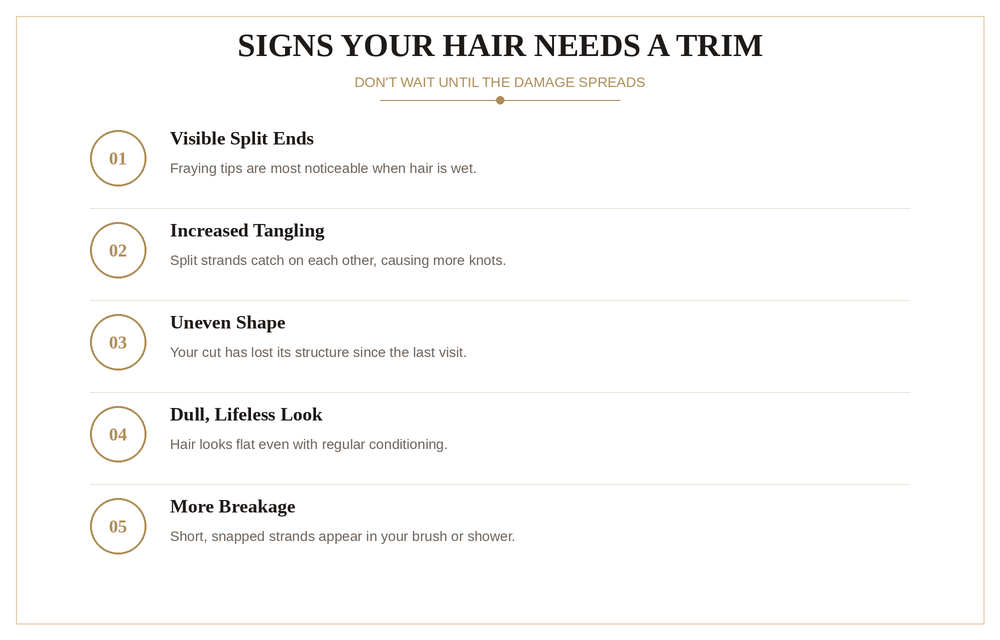
A proper split ends treatment at the salon involves precisely cutting above the damaged point, removing the fray entirely rather than just smoothing over it. Watch for these signs that you’re overdue: visible fraying when hair is wet, increased tangling, uneven shape, or hair that looks dull despite regular conditioning.
Hair Trimming Frequency vs Haircut Frequency: What’s Right for You?
There’s no single answer for how often to trim — the ideal hair trimming frequency depends on your hair type and goals. And if you’re due for a bigger style change rather than just maintenance, your haircut frequency will look a little different too:
| Hair Type / Goal | Trim Frequency | Full Haircut Frequency |
|---|---|---|
| Fine or fragile hair | Every 6–8 weeks | Every 3–4 months |
| Thick or coarse hair | Every 10–12 weeks | Every 4–6 months |
| Chemically treated or coloured hair | Every 6–8 weeks | Every 3–4 months |
| Growing hair out | Every 10–12 weeks (light dusting) | Rarely, unless reshaping |
| Maintaining a short style | Every 4–6 weeks | Every 4–6 weeks (trim and cut overlap) |
If you’re actively growing your hair out, it can feel counterproductive to trim regularly, but skipping trims for too long usually leads to more length loss from breakage than you’d lose from a small, consistent cut. A full haircut, on the other hand, is only needed when you want to reshape or change your style rather than simply maintain it.
Hair Breakage Prevention Beyond Trimming
While trims are essential, hair breakage prevention also depends on daily habits:
- Use a wide-tooth comb on wet hair to reduce snapping and pulling.
- Limit heat styling, or always apply a heat protectant beforehand.
- Avoid tight hairstyles that put constant tension on strands.
- Deep condition regularly to keep hair flexible rather than brittle.
- Protect hair while sleeping using a silk pillowcase or loose braid to reduce friction.
Combining these habits with regular hair trims gives you the best chance of maintaining long, healthy hair without constant breakage setbacks.
DIY Trims vs a Professional Salon Hair Trim
It might be tempting to trim your own ends at home, but a professional salon hair trim offers real advantages:
- Precision: Stylists use proper cutting techniques to remove damage without taking off more length than necessary.
- Even results: Professional trims maintain the shape and layers of your cut, which is difficult to replicate with household scissors.
- Better tools: Salon shears are sharper and designed specifically for hair, reducing further split ends from a dull blade.
DIY trims might save a visit occasionally, but for a cut that actually protects your length rather than damaging it further, professional precision makes a noticeable difference over time.
Common Myths About Hair Trimming
A few myths are worth clearing up:
- “Trimming makes hair grow faster.” Growth happens at the scalp — trims only prevent length loss from breakage.
- “Split end serums fix the problem permanently.” They only temporarily smooth the cuticle; the actual fix requires cutting off the damaged section.
- “Longer hair needs fewer trims.” Longer hair is actually more prone to dryness and breakage at the ends, since scalp oils take longer to travel down the length.
Understanding these myths helps set realistic expectations about what regular hair trims can and can’t do for your hair.
Visit Us: Hair Salon in Jakkur
Looking for a reliable hair salon in Jakkur to keep your ends healthy? At Scent Salon, our stylists don’t just trim on autopilot — every visit starts with a quick assessment of your hair’s condition, so you only lose the length that’s actually damaged. Our precision-cutting approach is designed to protect your length while still delivering clean, well-shaped results, whether you’re maintaining a short style or growing your hair out.
📅 Book Your Appointment
Conclusion
Regular hair trims aren’t just about maintaining a style — they’re one of the simplest, most effective ways to support healthy hair growth and prevent long-term damage. From reducing breakage to improving how your hair looks and feels day to day, the hair trim benefits add up quickly when done consistently.
Whether you’re maintaining a short style or growing your hair out, sticking to the right hair trimming frequency and choosing a professional salon hair trim over DIY scissors will keep your hair looking its healthiest.
FAQs
Does trimming hair actually make it grow faster?
No, trimming doesn’t affect growth at the scalp, but it prevents breakage that can offset growth, which often makes hair appear to grow longer and healthier over time.
How often should I get a hair trim?
It depends on your hair type, but most people benefit from a trim every 6–12 weeks, with fine or chemically treated hair needing more frequent visits.
What’s the difference between hair trimming frequency and haircut frequency?
Trimming frequency refers to small, regular maintenance cuts to remove damage, while haircut frequency refers to bigger style changes — most people need trims far more often than a full restyle.
Can split ends be repaired without cutting them?
No, split ends can only be temporarily smoothed with products — the only permanent fix is a proper split ends treatment that removes the damaged section.
Is it bad to skip trims while growing my hair out?
Skipping trims entirely often leads to more length loss from breakage than you’d lose from a small, regular trim, so light dusting every 10–12 weeks is usually recommended.
Is a professional trim really better than cutting my own hair at home?
Yes, professional stylists use precise techniques and sharper tools, resulting in more even, effective results compared to DIY trims at home.
Where can I book a professional hair trim near Jakkur, Bangalore?
Scent Salon in Jakkur offers professional hair trims, split ends treatment, and haircuts tailored to your hair type. You can book an appointment by phone, WhatsApp, or through our website.
Looking for more hair care tips? Explore our other blogs on hair fall solutions, deep conditioning treatments, and threading vs waxing.