Walk into two different salons offering the exact same services, and you’ll often walk out with two completely different feelings. That gap isn’t about price alone — it’s what actually defines a premium salon versus a purely functional one.
In this guide, we’ll look at what genuinely separates a luxury salon experience from an ordinary visit, including how a luxury hair salon differs from a standard one, why personalized hair services matter more than a longer menu, and why so many people are willing to pay more for a high-end salon. We’ll also touch on what to actually check if you’re searching for the best salon near me rather than just the closest option. If you’re nearby, we’ll show you what this looks like in practice at our premium salon in Jakkur.
Table of Contents
- It’s Not Just About the Service Menu
- What Defines a Luxury Hair Salon?
- The Role of Ambience in a Premium Salon
- Personalized Hair Services vs One-Size-Fits-All
- What Makes a Salon Genuinely Professional?
- Signature Touches That Set High-End Salons Apart
- Premium Salon vs Standard Salon: A Quick Comparison
- Finding the Best Salon Near Me (Without Settling for “Closest”)
- Red Flags That Signal a Salon Isn’t Truly Premium
- Visit Us: Premium Salon in Jakkur
- Conclusion
- FAQs
It’s Not Just About the Service Menu
Most salons, budget or premium, offer roughly the same list of services — haircuts, facials, manicures, waxing. What separates a premium salon isn’t necessarily a longer menu; it’s the quality of execution, consultation, and care behind each service.
A genuine luxury salon experience is really about the details surrounding the service: how you’re greeted, how thoroughly your needs are understood before work begins, and how consistently that same quality shows up on every single visit.
What Defines a Luxury Hair Salon?
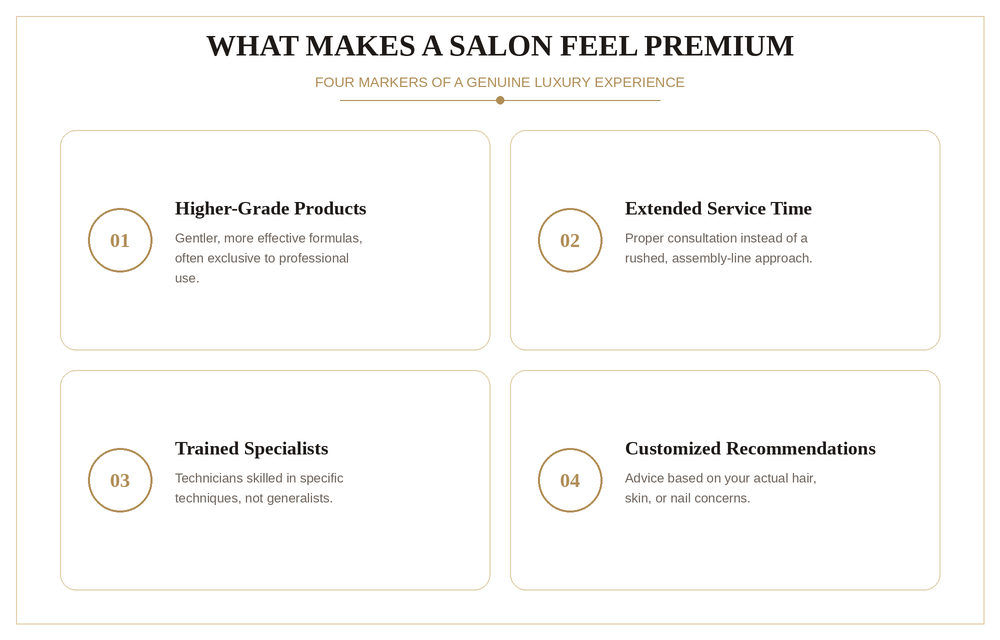
A luxury hair salon isn’t defined by price tags alone. A few genuine markers include:
- Higher-grade products that are gentler, more effective, and often exclusive to professional use.
- Extended service time, allowing for proper consultation rather than a rushed, assembly-line approach.
- Trained specialists rather than generalists handling every service with the same limited technique.
- Customized recommendations based on your specific hair, skin, or nail concerns, not a one-size-fits-all script.
These elements cost more to deliver consistently, which is part of why a luxury hair salon carries a different price point than basic alternatives.
The Role of Ambience in a Premium Salon
Walking into a well-designed, calm space genuinely changes how a service feels, even before anything begins. A premium salon in Bangalore typically invests in:
- Comfortable, well-maintained seating and stations
- Pleasant lighting that isn’t harsh or clinical
- A calm, unhurried pace rather than a rushed, high-turnover feel
- Clean, organized spaces that reflect attention to detail throughout
Ambience alone can’t replace skill, but it does shape the overall experience in ways that are easy to underestimate until you’ve felt the difference firsthand.
Personalized Hair Services vs One-Size-Fits-All
One of the clearest signs of a genuinely premium experience is how much attention goes into understanding you specifically, rather than applying the same routine to every client. Personalized hair services typically involve:
- A proper consultation before any service begins, covering your history, concerns, and goals
- Product and technique choices tailored to your specific hair, skin, or nail type
- Follow-up advice on maintaining results at home, rather than ending the conversation at checkout
- Consistency across visits, since your preferences and history are actually remembered and referenced
This kind of personalization takes more time and training to deliver, which is exactly why it’s a hallmark of premium, rather than purely transactional, service.
What Makes a Salon Genuinely Professional?
Professionalism goes beyond technical skill alone. A truly professional salon typically demonstrates:
- Transparent pricing with no unexpected charges or pressure to add unnecessary services
- Consistent hygiene standards, including sanitized tools and clean workstations
- Respect for appointment times, minimizing long, unexplained waits
- Ongoing staff training to stay current with techniques and safety standards
These standards matter just as much as the finished result, since they reflect how much a salon genuinely respects its clients’ time, safety, and trust.
Signature Touches That Set High-End Salons Apart
Beyond the core service, small signature touches often distinguish a high-end salon experience:
- A warm beverage or refreshment offered without being asked
- Thoughtful, unhurried consultations rather than rushed small talk
- Aftercare guidance tailored specifically to what was just done
- A genuinely relaxing atmosphere, rather than one that just looks polished in photos
These small details rarely appear on a price list, but they’re often what people remember and return for.
Premium Salon vs Standard Salon: A Quick Comparison
| Factor | Standard Salon | Premium Salon |
|---|---|---|
| Consultation | Brief or skipped entirely | Thorough, based on history and goals |
| Products used | Generic, mass-market | Higher-grade, often professional-exclusive |
| Staff training | Basic, generalized | Specialized, ongoing training |
| Pacing | Rushed, high turnover | Unhurried, focused on one client at a time |
| Aftercare guidance | Minimal or generic | Tailored to the specific service performed |
| Consistency | Varies by technician | Standardized across visits and staff |
This comparison isn’t about one being inherently good and the other bad — it simply reflects where the extra time, training, and cost of a premium experience typically shows up in practice.
Finding the Best Salon Near Me (Without Settling for “Closest”)
Searching for the best salon near me is a good starting point, but proximity alone doesn’t guarantee quality. Before booking based on location alone, it’s worth checking:
- Recent reviews mentioning consistency, not just a single great visit
- Whether the salon lists trained specialists for the specific service you need
- Photos of actual client results, not just stock or promotional images
- Clear service menus and pricing, rather than vague “starting from” figures
A slightly longer commute to a genuinely premium salon often delivers better long-term value than defaulting to whichever option appears first in a quick search.
Red Flags That Signal a Salon Isn’t Truly Premium
Not every salon charging premium prices actually delivers a premium experience. Watch for these warning signs:
- Rushed consultations that skip understanding your history or goals before starting a service
- Pressure to upgrade or add services you didn’t ask for, rather than genuine recommendations
- Inconsistent results between visits, suggesting a lack of proper training or standardized technique
- Unclean or worn tools and stations, regardless of how polished the reception area looks
- Staff who can’t clearly explain products or techniques being used during your service
A salon that’s genuinely premium should hold up to scrutiny in these areas, not just look the part on the surface.
Visit Us: Premium Salon in Jakkur
Looking for a premium salon in Jakkur that actually delivers on the luxury salon experience, not just the price tag? At Scent Salon, we combine trained specialists, personalized hair services, and a calm, welcoming space across hair, skin, and nail services, so every visit feels considered rather than routine.
📅 Book Your Appointment
Conclusion
What makes a premium salon worth choosing isn’t a single feature — it’s the combination of skilled technicians, genuine personalization, thoughtful ambience, and consistent professionalism across every visit. A true luxury hair salon costs more because it’s built around real attention to detail, not just branding.
If you’re deciding whether a luxury salon experience is worth the investment, the real test isn’t the price on the menu — it’s whether you leave feeling like your specific needs were actually understood and met.
FAQs
What actually makes a salon “premium” rather than just expensive?
It’s the combination of trained specialists, personalized consultations, quality products, and consistent professionalism — not price alone.
Is a luxury hair salon worth the higher cost?
Often yes, since it typically involves better products, more thorough consultations, and lower risk of mismatched or rushed results.
How can I tell if a salon is genuinely professional before booking?
Look for transparent pricing, visible hygiene standards, respect for appointment times, and staff who ask detailed questions during consultation.
Does ambience really affect the quality of a service?
While it doesn’t replace technical skill, a calm, well-designed space measurably improves the overall experience and comfort during a visit.
What should I expect from personalized hair services?
A proper consultation, tailored product and technique choices, and aftercare guidance specific to what was done, rather than a generic routine.
How do I find the best salon near me instead of just the closest one?
Check recent reviews for consistency, confirm specialists are available for your specific service, and look at real client results rather than relying on proximity alone.
Where can I experience a premium salon near Jakkur, Bangalore?
Scent Salon in Jakkur offers a full range of luxury beauty services across hair, skin, and nails. You can book an appointment by phone, WhatsApp, or through our website.
Looking for more salon tips? Explore our other blogs on choosing a premium hair salon, skin care treatments, and threading vs waxing.
Standing at the salon counter trying to pick a facial can feel harder than it should be. A hydrating facial and a brightening facial both promise glowing results, but they’re built to solve very different skin problems — and picking the wrong one can leave you disappointed even after a good treatment.
In this guide, we’ll break down what each treatment actually does, including how the Hydra Lifting Facial fixes dry, dehydrated skin specifically, and how options like the Snow White Facial, White Secret Facial, and Luminous Lightening Facial tackle dullness and uneven tone. We’ll also look at the Dead Sea Mineral Facial as a mineral-rich hydration option, and where glow-focused treatments like the Diamond Glow Facial and Gold Facial fit in as a skin brightening treatment. If you’re nearby, we’ll point you to a trusted facial salon in Sahakar Nagar where our team can assess your skin before recommending the right one.
Table of Contents
- What Is a Hydrating Facial? Meet the Hydra Lifting Facial
- What Is a Brightening Facial? Snow White, White Secret & Luminous Lightening
- Hydrating vs Brightening: Key Differences
- Signs You Need a Hydrating Treatment
- Signs You Need a Brightening Treatment
- Premium Glow Options: Diamond Glow and Gold Facial
- Can You Combine Hydration and Brightening?
- Visit Us: Facial Salon in Sahakar Nagar
- Conclusion
- FAQs
What Is a Hydrating Facial? Meet the Hydra Lifting Facial
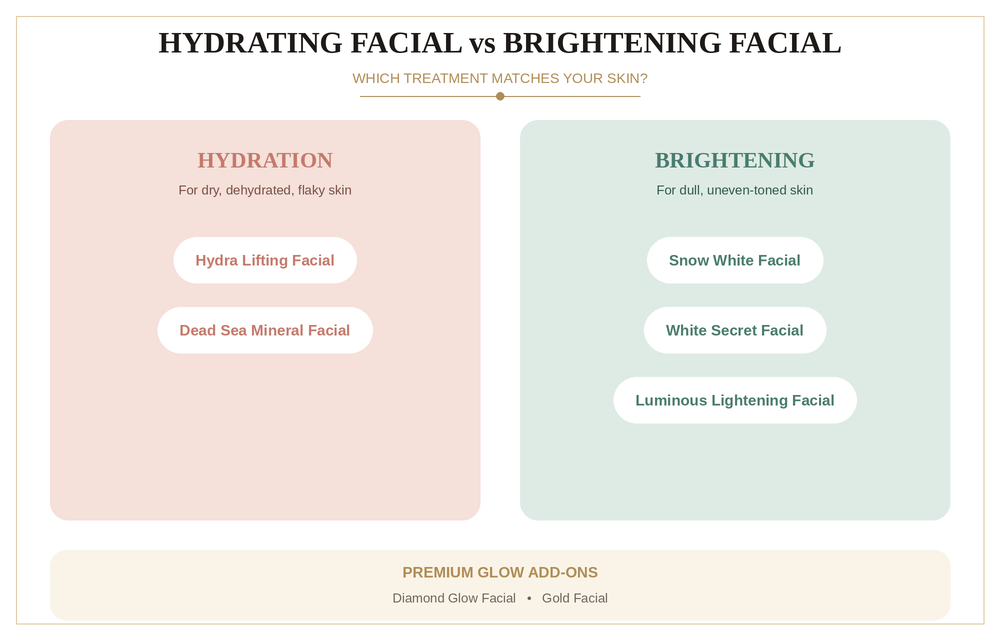
A hydrating facial is designed to restore moisture to skin that’s dehydrated, tight, or flaky. At Scent Salon, our Hydra Lifting Facial is built specifically for this, using moisture-binding ingredients to plump the skin and reduce the appearance of fine lines caused by dryness.
If you prefer a more mineral-based approach to hydration, the Dead Sea Mineral Facial offers a similar restorative effect using natural mineral-rich formulas, which can feel gentler for some skin types.
Unlike drinking more water, which affects overall body hydration, these treatments work directly on the skin’s surface and deeper layers, which is why results are often visible immediately after a session.
What Is a Brightening Facial? Snow White, White Secret & Luminous Lightening
A brightening facial focuses on evening out skin tone and reducing dullness. Scent Salon offers a few distinct options depending on how intensive you want the treatment to be:
- Snow White Facial: A classic brightening option aimed at reducing dullness and evening out tone.
- White Secret Facial: A more targeted treatment for pigmentation and uneven skin tone.
- Luminous Lightening Facial: Designed to add visible radiance and a brighter overall complexion.
Rather than adding moisture as the primary goal, these treatments work to resurface and brighten, which is why they’re often chosen before events or whenever skin looks visibly dull rather than dry.
Hydrating vs Brightening: Key Differences
| Factor | Hydra Lifting Facial | Snow White / Luminous Lightening |
|---|---|---|
| Best for | Dry, dehydrated, flaky skin | Dull, uneven-toned skin |
| Primary goal | Restore moisture and plumpness | Even tone and add radiance |
| Visible results | Softer, plumper skin | Brighter, more even complexion |
| Best timing | Anytime skin feels tight or dry | Before events or when skin looks dull |
Neither treatment is universally better — the right choice depends entirely on what your skin is actually asking for.
Signs You Need a Hydrating Treatment
If your skin is asking for a Hydra Lifting Facial or Dead Sea Mineral Facial rather than a brightening treatment, you’ll likely notice:
- Tightness, especially after cleansing or during colder months
- Visible flaking or rough patches, particularly around the nose and cheeks
- Fine lines that appear more pronounced when skin feels dehydrated
- Skin that absorbs moisturizer quickly but still feels dry within hours
These treatments address these concerns directly by replenishing moisture at a deeper level than home skincare alone.
Signs You Need a Brightening Treatment
On the other hand, if dullness rather than dryness is your main concern, the Snow White, White Secret, or Luminous Lightening Facial is likely the better fit:
- Uneven skin tone or visible dark spots
- A generally tired, lackluster complexion despite adequate hydration
- Sun damage or pigmentation that’s become more noticeable over time
- A need for a quick, visible boost before a specific event
If your skin feels adequately moisturized but still looks flat or uneven, brightening — not hydration — is likely the missing piece.
Premium Glow Options: Diamond Glow and Gold Facial
If you want a treatment that leans into visible radiance as much as brightening, two premium options are worth considering:
- Diamond Glow Facial: Combines exfoliation with infusion, leaving skin smoother and noticeably more radiant.
- Gold Facial: A luxurious option often chosen for special occasions, known for leaving skin with an instant, visible glow.
Both work well as a skin brightening treatment on their own, or as an occasional upgrade to a regular hydrating or brightening routine.
Can You Combine Hydration and Brightening?
In many cases, yes. Skin can be both dehydrated and dull at the same time, and our estheticians can layer elements of a Hydra Lifting Facial with a brightening option like Snow White or Luminous Lightening into a single session. If you’re unsure which single treatment to choose, a quick consultation can help determine whether your skin needs one focused treatment or a blended approach.
That said, combining treatments isn’t always necessary — sometimes addressing the primary concern alone resolves the secondary one as a side effect, since hydrated skin often looks brighter simply as a result of improved texture.
Visit Us: Facial Salon in Sahakar Nagar
Looking for a reliable facial salon in Sahakar Nagar to help you choose between these options? At Scent Salon, our estheticians assess your skin before recommending a Hydra Lifting Facial, a brightening option like Snow White or Luminous Lightening, or a combined approach, ensuring you get a treatment that actually matches what your skin needs.
📅 Book Your Appointment
Conclusion
Choosing between a hydrating facial and a brightening facial doesn’t need to be complicated once you know what your skin is actually telling you. Tightness and flakiness point toward the Hydra Lifting Facial or Dead Sea Mineral Facial, while unevenness and dullness point toward the Snow White, White Secret, or Luminous Lightening Facial — and for an extra glow boost, Diamond Glow and Gold Facial are worth considering as premium options.
Rather than picking based on trends or what worked for someone else, matching the right treatment to your specific concern is what delivers results you’ll actually notice.
FAQs
What is the main difference between a hydrating facial and a brightening facial?
A hydrating facial like the Hydra Lifting Facial focuses on restoring moisture to dry or dehydrated skin, while brightening options like Snow White or Luminous Lightening focus on evening out tone and reducing dullness.
Can I get a hydrating facial if my skin is oily?
Yes, oily skin can still be dehydrated underneath excess oil production, so a lightweight hydrating treatment can still be beneficial.
How often should I get a brightening facial?
Once a month is generally sufficient for most people, or more frequently before a specific event if a quick glow boost is needed.
What’s the difference between Snow White, White Secret, and Luminous Lightening?
All three target brightening, but White Secret is more focused on pigmentation, Snow White is a classic all-round brightening option, and Luminous Lightening emphasizes visible radiance.
Is the Dead Sea Mineral Facial better than the Hydra Lifting Facial?
Neither is strictly better — the Dead Sea Mineral Facial uses natural mineral ingredients and can feel gentler, while the Hydra Lifting Facial is more targeted toward deep moisture and plumping.
Are Diamond Glow and Gold Facial suitable for regular use?
They can be, though many people choose them occasionally for events or as a periodic upgrade rather than a routine monthly treatment.
Where can I book a facial consultation near Sahakar Nagar, Bangalore?
Scent Salon in Sahakar Nagar offers Hydra Lifting, Snow White, White Secret, Luminous Lightening, Diamond Glow, and Gold Facial treatments, along with professional consultations. You can book an appointment by phone, WhatsApp, or through our website.
Looking for more skin care tips? Explore our other blogs on skin care treatments, professional cleanup treatments, and deep conditioning treatments.
Grooming for men has moved well past a quick trim and a splash of aftershave. Today, men’s grooming covers everything from precision haircuts to detailed beard work, and getting it right makes a noticeable difference in how put-together you look and feel day to day.
In this guide, we’ll walk through what to expect from a proper men’s haircut, the essentials of beard grooming, and how services like beard styling, beard trimming, and a classic hot towel shave fit into a complete routine. We’ll also cover what separates a good men’s hair salon from an average one, and what genuinely professional men’s grooming looks like in practice. If you’re nearby, we’ll point you to a trusted men’s salon in Jakkur where you can get it all done in one visit.
Table of Contents
- Why Men’s Grooming Deserves More Attention
- Getting the Right Men’s Haircut for Your Face Shape
- Beard Grooming Basics Everyone Should Know
- Beard Styling vs Beard Trimming: What’s the Difference?
- The Case for a Classic Hot Towel Shave
- What to Look for in a Men’s Hair Salon
- Building a Simple At-Home Grooming Routine
- Common Grooming Mistakes to Avoid
- Visit Us: Men’s Salon in Jakkur
- Conclusion
- FAQs
Why Men’s Grooming Deserves More Attention
Grooming isn’t vanity — it’s maintenance, the same way you’d service a car or maintain any other part of your routine. Well-kept hair and a properly shaped beard affect first impressions in professional and social settings alike, often more than people realize.
Beyond appearance, proper men’s grooming also supports better skin and scalp health, since regular trims and shaves prevent the kind of buildup, ingrown hairs, and irritation that come from inconsistent care.
Getting the Right Men’s Haircut for Your Face Shape
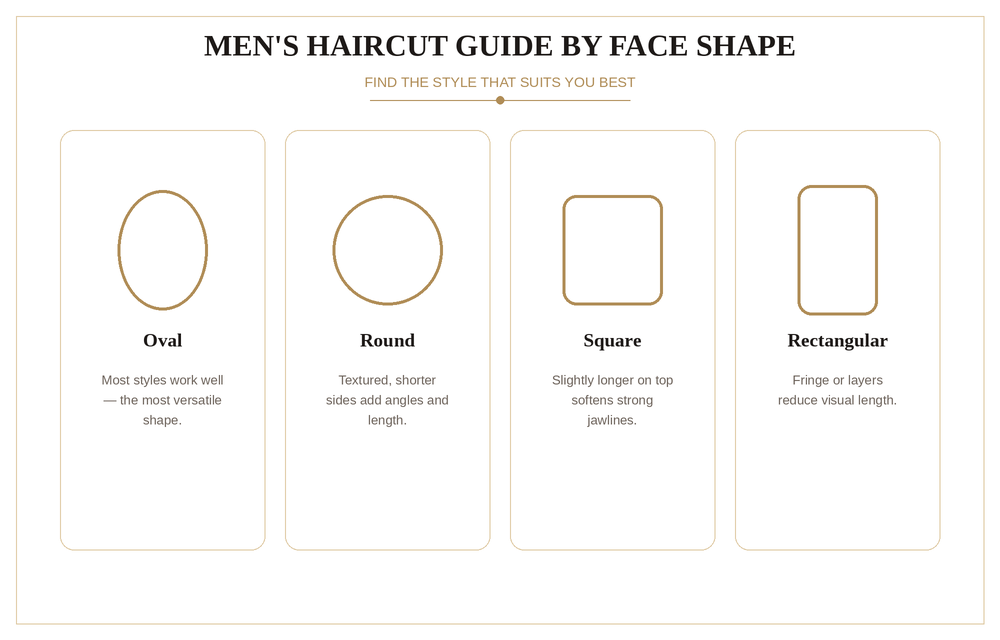
Not every haircut works for every face, and a good men’s haircut should be chosen with that in mind:
- Oval face: Most styles work well; this is the most versatile face shape for haircuts.
- Round face: Textured, shorter-on-the-sides cuts help add angles and length visually.
- Square face: Slightly longer styles on top soften strong jawlines.
- Rectangular face: Fringe or layered styles help reduce the appearance of length.
A good stylist will assess your face shape and hair texture before recommending a cut, rather than applying the same style to everyone who sits in the chair.
Beard Grooming Basics Everyone Should Know
Whether you’re maintaining stubble or a full beard, consistent beard grooming makes a visible difference:
- Wash regularly with a beard-specific cleanser to avoid dryness and flaking.
- Condition the beard, not just the hair on your head, since facial hair tends to be coarser and drier.
- Comb or brush daily to train hair growth direction and prevent tangling.
- Trim stray hairs between professional visits to maintain a clean edge.
- Moisturize the skin underneath, since beard dandruff often comes from dry skin, not the hair itself.
These basics apply whether you’re growing out a beard or maintaining a shorter, more manicured look.
Beard Styling vs Beard Trimming: What’s the Difference?
These terms often get used interchangeably, but they serve different purposes:
| Service | Focus | Best For |
|---|---|---|
| Beard trimming | Removing length, maintaining shape | Regular upkeep every 2–3 weeks |
| Beard styling | Shaping to suit face structure | New looks, special occasions |
| Beard shaping | Sculpting sharp, defined lines | Precision, structured styles |
| Beard coloring | Covering grays or changing tone | Cosmetic changes |
A trim keeps an existing style neat, while styling is more about shaping or changing the look entirely — knowing which one you actually need helps you communicate clearly with your stylist.
The Case for a Classic Hot Towel Shave
A hot towel shave is one of grooming’s oldest traditions, and it remains popular for good reason. The heat opens pores and softens hair, allowing for a closer, more comfortable shave than most people manage at home. It’s typically followed by a soothing aftershave application, leaving skin smooth and noticeably less irritated than a rushed at-home routine.
Beyond the practical benefits, a hot towel shave is also one of the more relaxing grooming services available — a genuine pause in an otherwise busy routine.
What to Look for in a Men’s Hair Salon
Not every salon handles men’s grooming with the same attention to detail. Before booking, consider:
- Dedicated men’s services, rather than a generic unisex menu with no specialization
- Experienced barbers or stylists specifically trained in men’s cuts and beard work
- Proper hygiene standards, including sanitized tools and clean stations
- A relaxed, unhurried atmosphere, since rushed services often show in the final result
- Clear service menus, so you know exactly what each visit includes
A men’s hair salon that checks these boxes tends to deliver noticeably better, more consistent results over repeated visits.
Building a Simple At-Home Grooming Routine
Between salon visits, a few consistent habits help maintain your results:
- Use a proper shampoo and conditioner suited to your hair type, not just whatever’s in the shower.
- Apply a lightweight styling product rather than overloading hair with heavy gels or waxes.
- Trim beard stray hairs every few days to maintain shape between professional visits.
- Moisturize your face daily, especially if you shave regularly, to prevent dryness and irritation.
This routine doesn’t need to be complicated — a few consistent habits go further than an elaborate one you won’t stick to.
Common Grooming Mistakes to Avoid
Even well-intentioned routines can be undone by a few common habits:
- Skipping regular trims and only visiting the salon when hair or beard growth becomes unmanageable, rather than on a consistent schedule.
- Using the wrong products for your hair or skin type, which can lead to dryness, buildup, or irritation over time.
- Shaving against the grain without proper prep, increasing the risk of razor burn and ingrown hairs.
- Ignoring the skin underneath a beard, which often causes more irritation than the facial hair itself.
- Copying a style that doesn’t suit your face shape or hair texture, rather than getting guidance from a stylist first.
- Over-styling with heavy products, which can look unnatural and make hair harder to manage day to day.
Avoiding these mistakes is often the difference between a routine that looks effortless and one that constantly needs fixing.
Visit Us: Men’s Salon in Jakkur
Looking for a reliable men’s salon in Jakkur for haircuts and beard work? At Scent Salon, our stylists offer everything from precision men’s haircuts to detailed beard artistry, including beard trimming, styling, shaping, coloring, and a classic hot towel shave — all in one relaxed, professional setting.
📅 Book Your Appointment
Conclusion
A complete men’s grooming routine goes well beyond a quick haircut — it includes proper beard grooming, understanding the real difference between beard styling and beard trimming, and knowing what to look for in a men’s hair salon that actually specializes in men’s services. Add in something like a classic hot towel shave now and then, and you’ve got a routine that keeps you looking sharp consistently, not just after the occasional big event.
Whether you’re maintaining a simple, low-effort look or investing in a more detailed grooming routine, professional care makes a difference that’s hard to replicate at home alone.
FAQs
How often should men get a haircut?
Most men benefit from a haircut every 3–5 weeks, though this varies based on hair type, length, and how quickly your style grows out.
What’s the difference between beard trimming and beard styling?
Beard trimming maintains an existing shape by removing length, while beard styling involves shaping the beard to suit your face structure or achieve a new look entirely.
Is a hot towel shave better than shaving at home?
Yes, generally — the heat and steam soften hair and open pores, allowing for a closer, more comfortable shave with less irritation than most at-home routines.
How do I choose the right haircut for my face shape?
A good stylist will assess your face shape and hair texture during a consultation, but generally, round faces benefit from added angles while square faces suit softer, longer styles on top.
How often should beard grooming be done professionally?
Professional beard trims or shaping every 2–3 weeks help maintain a clean, defined look between at-home touch-ups.
What should I look for in a good men’s hair salon?
Look for dedicated men’s services, experienced stylists, proper hygiene standards, and a clear service menu rather than a generic, unspecialized approach.
Where can I find a professional men’s salon near Jakkur, Bangalore?
Scent Salon in Jakkur offers a full range of men’s grooming services, including haircuts, beard trimming, beard styling, and hot towel shaves. You can book an appointment by phone, WhatsApp, or through our website.
Looking for more grooming and beauty tips? Explore our other blogs on hair fall solutions, threading vs waxing, and premium hair salon essentials.
Your feet carry you through every single day, yet they’re often the last thing on the self-care list. A professional pedicure does more than leave your toes looking polished — it’s a genuine spa pedicure experience that improves circulation and gives you a real moment of relaxation most people rarely make time for.
In this guide, we’ll look at how a pedicure benefits go beyond appearance, the difference between an organic pedicure and a regular one, what a gel pedicure finish actually involves, why a foot spa treatment doubles as a relaxing spa pedicure, and how to build a simple foot care routine at home between visits. If you’re nearby, we’ll point you to a trusted pedicure and nail salon in Sahakar Nagar where you can experience it firsthand.
Table of Contents
- What Happens During a Professional Pedicure?
- Pedicure Benefits Beyond Pretty Toes
- Organic Pedicure vs Regular Pedicure
- Gel Pedicure: Is It Worth It?
- Why a Pedicure Doubles as a Relaxing Spa Pedicure
- The Relaxation Factor: Why Pedicures Reduce Stress
- How Often Should You Get a Pedicure?
- Building a Foot Care Routine Between Pedicure Visits
- Visit Us: Nail Salon in Sahakar Nagar
- Conclusion
- FAQs
What Happens During a Professional Pedicure?
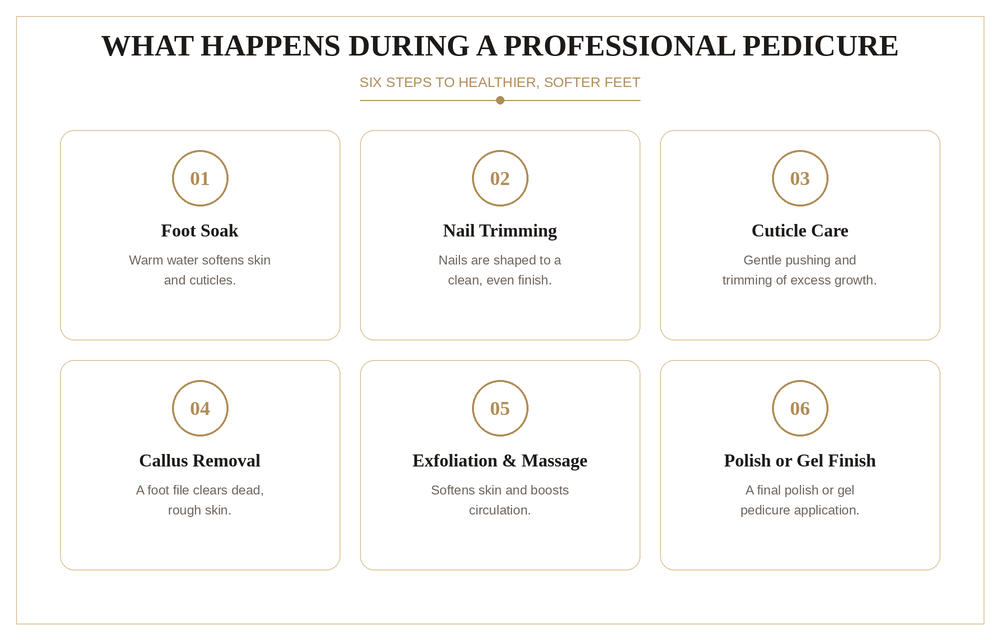
A typical professional pedicure involves more steps than most people realize:
- Foot soak in warm water to soften skin and cuticles
- Nail trimming and shaping to a clean, even finish
- Cuticle care using a pusher and cutter to remove excess growth
- Callus and dead skin removal using a foot file or scrubber
- Exfoliation and massage to soften skin and boost circulation
- Polish or gel pedicure application to finish the look
Each step serves a purpose beyond aesthetics — cuticle care alone helps prevent infections, while regular callus removal keeps feet comfortable in daily footwear.
Pedicure Benefits Beyond Pretty Toes
The most obvious pedicure benefits are cosmetic, but the real value runs deeper:
- Improved circulation: The massage component increases blood flow to the feet and lower legs, which can ease stiffness and fatigue.
- Early detection of issues: A trained technician can spot early signs of fungal infections, ingrown nails, or skin conditions before they worsen.
- Reduced risk of infection: Proper cuticle care and sanitized tools lower the chances of bacterial or fungal problems compared to DIY foot care.
- Softer, healthier skin: Regular exfoliation prevents painful cracking, especially around the heels.
- Better nail health: Consistent trimming and shaping reduce the risk of ingrown toenails and breakage.
Organic Pedicure vs Regular Pedicure
If you have sensitive skin or simply prefer a gentler approach, an organic pedicure swaps synthetic soaks and scrubs for natural ingredients like Epsom salts, essential oils, and plant-based exfoliants. It’s a calming, spa-like experience that’s especially popular for those looking to combine self-care with relaxation.
A regular pedicure may use slightly stronger active ingredients for faster callus removal or more intensive exfoliation, which can work well for feet that see a lot of wear from daily activity or footwear. Neither is inherently better — the right choice depends on your skin sensitivity and how much time you have.
Gel Pedicure: Is It Worth It?
A gel pedicure uses a UV-cured polish that resists chipping far longer than regular polish, often lasting two to three weeks compared to about a week for standard polish. It’s a good option if you want low-maintenance, long-lasting results, though proper removal by a professional is important to avoid weakening the natural nail underneath.
If you switch between gel and regular polish, giving your nails an occasional break helps maintain overall nail health over time.
Why a Pedicure Doubles as a Relaxing Spa Pedicure
Beyond a single quick session, a proper spa pedicure offers real, lasting value that goes past the polish:
- Preventing calluses and cracked heels from becoming painful or infected
- Catching ingrown toenails early, before they require medical treatment
- Improving circulation in the feet and lower legs, which can ease stiffness and fatigue
- Keeping skin moisturized, which reduces the risk of fungal infections in dry, cracked areas
For people who spend long hours on their feet or wear closed shoes daily, a spa pedicure is arguably as valuable for physical comfort as it is for relaxation.
The Relaxation Factor: Why Pedicures Reduce Stress
The foot soak, massage, and unhurried pace of a pedicure aren’t just pleasant extras — they have a real physiological effect. Foot massage stimulates pressure points linked to relaxation throughout the body, while the simple act of sitting still for 30–45 minutes gives many people a rare, guilt-free break from daily demands.
This is part of why an organic pedicure, in particular, is often chosen specifically for its calming, sensory experience rather than just the end result.
How Often Should You Get a Pedicure?
Based on typical nail growth and wear:
- Standard pedicure: Every 4–6 weeks for most people
- Gel pedicure: Every 3 weeks, timed with when the gel begins to grow out
- Organic pedicure: Every 4–6 weeks, or more often if primarily used for relaxation
- Active lifestyles or frequent closed footwear: Every 3–4 weeks to manage calluses and pressure points
Sticking to a consistent schedule prevents small issues from turning into bigger, more uncomfortable ones between visits.
Building a Foot Care Routine Between Pedicure Visits
A simple foot care routine helps maintain your results and keep feet comfortable between professional sessions:
- Moisturize daily, especially on heels and dry patches, to prevent cracking.
- Wear breathable footwear when possible, since closed shoes trap moisture and can worsen fungal risk.
- Avoid cutting cuticles yourself, since improper trimming increases infection risk — leave this to a trained technician.
- Change socks regularly, particularly after exercise, to keep feet dry throughout the day.
- Don’t ignore early signs of ingrown nails or discoloration — a quick professional check is far easier than treating a worsened issue later.
These small habits, paired with regular professional visits, keep feet in noticeably better condition year-round.
Visit Us: Nail Salon in Sahakar Nagar
Looking for a reliable nail salon in Sahakar Nagar for your next pedicure? At Scent Salon, our pedicure and nail care menu includes both classic and organic pedicure options, along with gel finishes, all performed with sanitized tools and a focus on genuine foot health, not just polish.
📅 Book Your Appointment
Conclusion
A professional pedicure is far more than a cosmetic treat — from improved circulation to early detection of foot issues, the pedicure benefits extend well beyond how your toes look afterward. Whether you choose an organic pedicure for a gentler, spa-like experience or a gel pedicure for long-lasting results, consistent visits are what actually support foot health over time.
If you’re due for some relaxation and better foot care in one visit, a professional pedicure is one of the simplest ways to check both boxes at once.
FAQs
How often should I get a professional pedicure?
Most people benefit from a pedicure every 4–6 weeks, though those with active lifestyles or frequent closed footwear may need it slightly more often.
What is the difference between an organic pedicure and a regular pedicure?
An organic pedicure uses natural, plant-based ingredients and is gentler on sensitive skin, while a regular pedicure may use stronger actives for faster exfoliation and callus removal.
Does a gel pedicure damage nails?
When applied and removed professionally, gel pedicures shouldn’t significantly damage natural nails, though occasional breaks help maintain overall nail health.
What makes a pedicure feel like a spa pedicure rather than a quick service?
Elements like a longer foot soak, aromatic oils, extended massage time, and a calm, unhurried pace are what turn a standard pedicure into a true spa pedicure experience.
Are pedicures actually good for foot health, or just cosmetic?
Both — pedicures offer real foot health benefits like improved circulation, early issue detection, and reduced infection risk, alongside the cosmetic results.
Is an organic pedicure worth the extra relaxation focus?
If stress relief and a calming, spa-like experience matter to you as much as the results, an organic pedicure is often worth choosing over a standard option.
Where can I book a professional pedicure near Sahakar Nagar, Bangalore?
Scent Salon in Sahakar Nagar offers professional pedicures, including organic and gel pedicure options. You can book an appointment by phone, WhatsApp, or through our website.
Looking for more nail and beauty care tips? Explore our other blogs on manicure and pedicure benefits, hair fall solutions, and deep conditioning treatments.
Walking out of the salon with silky, frizz-free hair feels amazing — but what you do in the days and weeks after matters just as much as the treatment itself. Proper hair smoothening aftercare is what determines whether your results last three months or fade within a few weeks.
In this guide, we’ll walk through exactly how to protect your hair smoothening treatment, share practical silky hair tips, and explain how to maintain frizz-free hair without undoing your results. We’ll also cover smoothening hair care basics, what post smoothening care actually involves in the first 72 hours, and simple habits for smooth hair maintenance long after your salon visit. If you’re nearby, we’ll point you to a trusted hair salon in Sahakar Nagar where you can get the treatment done right from the start.
Table of Contents
- Why Aftercare Matters More Than the Treatment Itself
- The First 72 Hours After Smoothening
- Building a Smoothening Hair Care Routine
- Products to Use (and Avoid) After Smoothening
- Silky Hair Tips for Everyday Maintenance
- Common Mistakes That Undo Your Results
- How Long Should Results Last?
- Aftercare Differences by Hair Type
- Visit Us: Hair Salon in Sahakar Nagar
- Conclusion
- FAQs
Why Aftercare Matters More Than the Treatment Itself
A hair smoothening treatment works by reshaping the hair’s structure using heat and specific formulas, but that structure remains vulnerable for the first few days afterward. Washing too soon, tying your hair up, or using the wrong products can reverse the smoothening process before it fully sets, which is why aftercare isn’t optional — it’s really an extension of the treatment itself.
Think of the salon visit as step one and your post smoothening care as step two; skipping the second step often means paying for a treatment that doesn’t last anywhere near as long as it should.
The First 72 Hours After Smoothening
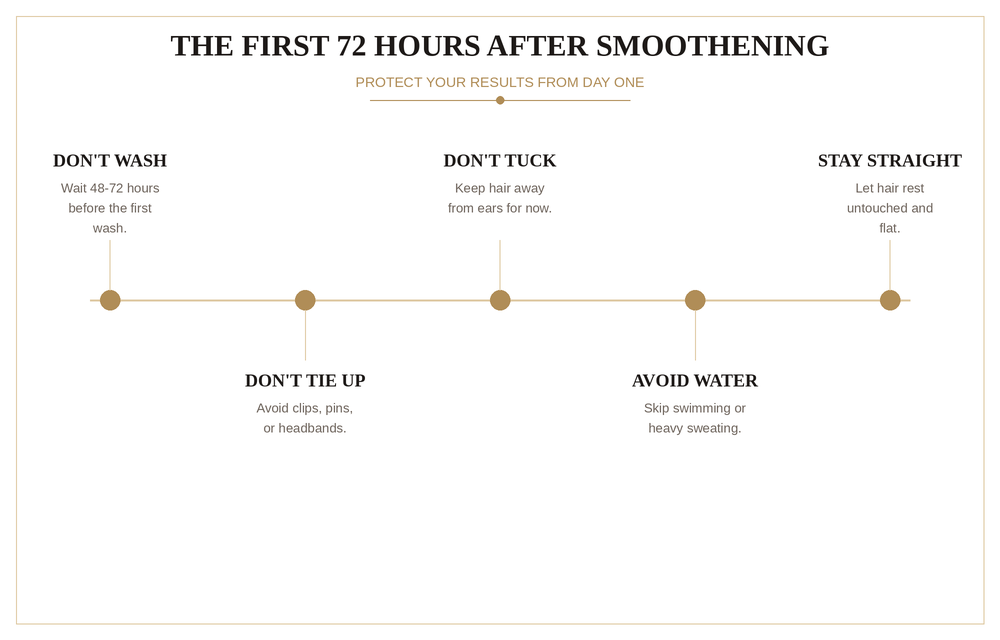
This window is the most critical part of your entire hair smoothening aftercare routine:
- Avoid washing your hair for at least 48–72 hours, as instructed by your stylist, to let the treatment fully set.
- Don’t tie your hair up or use clips, pins, or headbands that could create creases or kinks.
- Avoid tucking hair behind your ears for extended periods, since this can leave a visible bend once the style sets.
- Skip swimming or heavy sweating during this period, as moisture and salt or chlorine can interfere with the treatment.
- Keep hair straight and untouched as much as possible, letting the formula bond properly with each strand.
Rushing this stage is one of the most common reasons people feel disappointed with results that were otherwise done correctly.
Building a Smoothening Hair Care Routine
Once you’re past the initial waiting period, a consistent routine helps extend your results for months rather than weeks:
- Use sulfate-free shampoo, since sulfates strip the smoothening treatment faster than gentler formulas.
- Space out washes, aiming for two to three times a week rather than daily washing.
- Apply a lightweight, silicone-based serum to maintain shine without weighing hair down.
- Deep condition weekly to keep hair hydrated, since smoothening treatments can leave strands slightly drier.
- Use lukewarm water instead of hot water, which can strip both moisture and treatment longevity.
This routine doesn’t need to be complicated — consistency matters far more than any single product.
Products to Use (and Avoid) After Smoothening
Not all hair products are treatment-safe. Here’s a quick guide:
| Use These | Avoid These |
|---|---|
| Sulfate-free shampoo | Clarifying or deep-cleansing shampoo |
| Silicone-based serums | Heavy oils applied to roots |
| Leave-in conditioners | Alcohol-based styling sprays |
| Heat protectant sprays | High-heat styling without protection |
| Wide-tooth combs | Fine-tooth combs or aggressive brushing |
Reading ingredient labels before buying new products can save you from accidentally undoing weeks of careful maintenance.
Silky Hair Tips for Everyday Maintenance
Beyond product choice, small daily habits go a long way toward keeping hair looking salon-fresh:
- Sleep on a silk or satin pillowcase to reduce friction and frizz overnight.
- Avoid tight hairstyles that create tension and potential kinks near the roots.
- Limit heat styling frequency, and always use a heat protectant when you do style.
- Protect hair from humidity with an anti-frizz spray on particularly damp or rainy days.
- Trim regularly to prevent split ends from making hair look less sleek overall.
These silky hair tips work well whether you’ve had a smoothening treatment or simply want healthier-looking hair day to day.
Common Mistakes That Undo Your Results
Even well-intentioned habits can shorten how long your treatment lasts:
- Washing too soon after the treatment, before the formula has fully set.
- Using regular shampoo instead of a sulfate-free, treatment-safe formula.
- Overloading hair with oils, which can make it look greasy rather than smooth.
- Skipping heat protectant when using styling tools, leading to faster wear on treated strands.
- Ignoring split ends, which make even smoothened hair look less polished over time.
Avoiding these mistakes is often the difference between results that last two months versus results that fade within a few weeks.
How Long Should Results Last?
With proper hair smoothening aftercare, most treatments last between three and six months, depending on hair type, product use, and how quickly your hair grows out. Fine hair tends to hold results longer, while thicker or more resistant hair textures may see the effects fade slightly sooner. Regular touch-ups at the roots, rather than a full re-treatment, are often enough to maintain the look as new growth comes in.
Aftercare Differences by Hair Type
Not all hair responds to smoothening the same way, and aftercare should adjust accordingly:
- Fine hair: Tends to hold smoothening results the longest, but is also more prone to looking flat if heavy oils or serums are overused.
- Thick or coarse hair: May need slightly more frequent conditioning to stay soft, since thicker strands can dry out faster after treatment.
- Colour-treated hair: Requires extra caution with product choice, since combining smoothening with colour maintenance products can sometimes cause buildup or dullness.
- Curly or wavy hair (post-smoothening): New growth at the roots will still show natural texture, so root touch-ups are typically needed sooner than with naturally straighter hair.
Understanding how your specific hair type responds helps you fine-tune your routine rather than following generic advice that may not apply to your strands.
Visit Us: Hair Salon in Sahakar Nagar
Looking for a reliable hair salon in Sahakar Nagar to get your smoothening treatment done right? At Scent Salon, our stylists don’t just apply the treatment — they walk you through a complete post smoothening care plan, so you know exactly how to protect your results from day one.
📅 Book Your Appointment
Conclusion
A great hair smoothening treatment can go to waste without the right aftercare. Following proper steps in the first 72 hours, building a consistent smoothening hair care routine, and avoiding common product mistakes are what actually determine whether your hair stays silky for months or reverts to frizz within weeks.
Whether you’re fresh out of the salon chair or a few weeks into your treatment, sticking to these habits for smooth hair maintenance will help you get the most value out of every session.
FAQs
How soon can I wash my hair after a smoothening treatment?
Most stylists recommend waiting 48–72 hours before the first wash, allowing the treatment to fully set into the hair structure.
Can I tie my hair up right after smoothening?
It’s best to avoid tying your hair, using clips, or tucking it behind your ears for the first few days, since this can create creases as the treatment sets.
What shampoo should I use after hair smoothening?
A sulfate-free shampoo is recommended, since regular or clarifying shampoos can strip the treatment and shorten how long results last.
How long does a hair smoothening treatment typically last?
With proper aftercare, results usually last three to six months, depending on hair type and how well the aftercare routine is followed.
Can I still colour my hair after a smoothening treatment?
Yes, but it’s best to wait at least two weeks and consult your stylist, since combining chemical treatments too closely together can increase damage risk.
Does heat styling ruin smoothened hair?
Not necessarily, but skipping heat protectant or using very high temperatures can wear down the treatment faster than expected.
Where can I get a professional hair smoothening treatment near Sahakar Nagar, Bangalore?
Scent Salon in Sahakar Nagar offers professional hair smoothening treatments along with detailed aftercare guidance. You can book an appointment by phone, WhatsApp, or through our website.
Looking for more hair care tips? Explore our other blogs on hair fall solutions, deep conditioning treatments, and threading vs waxing.
Between pollution, makeup residue, and everyday grime, your skin builds up more buildup than you’d think — even with a solid daily skincare routine. A professional cleanup treatment goes deeper than any home routine can, clearing out impurities and leaving skin visibly fresher within a single session.
In this guide, we’ll break down what a facial cleanup actually involves, why it’s one of the fastest ways to restore radiant skin, and how it compares to a deeper skin glow treatment. We’ll also look at organic cleanup options for sensitive skin, how a deep cleansing facial helps with specific concerns, and where an acne cure facial or anti ageing facial fits into the picture. If you’re nearby, we’ll point you to a facial salon in Jakkur where you can experience it firsthand.
Table of Contents
- What Is a Cleanup Treatment?
- Why a Facial Cleanup Delivers Radiant Skin Fast
- Organic Cleanup vs Regular Cleanup
- Cleanup Treatment vs a Full Skin Glow Treatment
- Who Benefits Most from a Deep Cleansing Facial?
- Cleanup for Acne-Prone and Ageing Skin
- How Often Should You Get a Cleanup?
- Common Cleanup Mistakes to Avoid
- Visit Us: Facial Salon in Jakkur
- Conclusion
- FAQs
What Is a Cleanup Treatment?
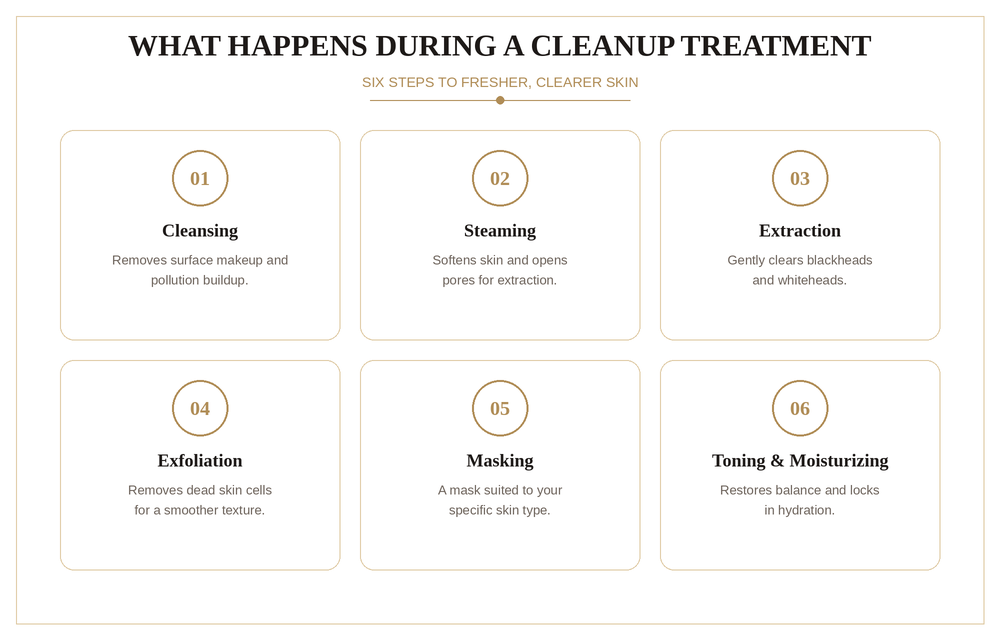
A cleanup treatment is a focused skin service designed to clear out dirt, dead skin cells, and clogged pores without the more intensive steps of a full facial. It typically includes:
- Cleansing to remove surface makeup and pollution buildup
- Steaming to soften and open pores
- Extraction to gently clear blackheads and whiteheads
- Light exfoliation to remove dead skin cells
- A mask suited to your skin type
- Toning and moisturizing to finish
It’s quick, low-commitment, and one of the most accessible ways to keep skin looking fresh between more intensive treatments.
Why a Facial Cleanup Delivers Radiant Skin Fast
Unlike a basic wash, a facial cleanup reaches beneath the surface layer of skin, which is exactly why results are visible almost immediately. Removing built-up oil and dead skin cells allows light to reflect more evenly off the skin, which is what actually creates that fresh, radiant skin look people notice right after a session.
Regular cleanups also prevent the kind of buildup that leads to duller, congested-looking skin over time — making it easier to maintain results between bigger treatments.
Organic Cleanup vs Regular Cleanup
If you prefer gentler, chemical-free options, an organic cleanup swaps synthetic exfoliants and masks for plant-based ingredients like fruit enzymes, clay, and natural oils. It’s a good fit if you have sensitive skin, or simply prefer a more natural approach to your skin care routine.
A regular cleanup, on the other hand, may use slightly stronger active ingredients for faster results, which can work well for oilier or more resilient skin types. Neither option is inherently better — the right choice depends on your skin’s sensitivity and how it typically reacts to new products.
Cleanup Treatment vs a Full Skin Glow Treatment
It’s easy to confuse a quick cleanup with a more involved skin glow treatment, but they serve different purposes:
| Factor | Cleanup Treatment | Skin Glow Treatment |
|---|---|---|
| Duration | 20–30 minutes | 45–75 minutes |
| Focus | Surface cleansing, extraction | Brightening, hydration, tone |
| Ingredients | Basic cleansers, light masks | Vitamin C, brightening actives |
| Best for | Regular maintenance | Special occasions, dullness |
| Frequency | Every 2–3 weeks | Once a month |
A cleanup keeps skin clear on an ongoing basis, while a dedicated glow treatment is better suited for a more noticeable, longer-lasting brightening effect.
Who Benefits Most from a Deep Cleansing Facial?
A deep cleansing facial goes a step further than a standard cleanup, targeting more stubborn congestion. It’s particularly useful for:
- People with oily or combination skin prone to clogged pores
- Anyone living in high-pollution areas where daily buildup is heavier
- Those preparing for an event who want a noticeably clearer complexion
- Skin that feels persistently rough or bumpy despite regular cleansing
While a deep cleansing facial can feel more intensive, it’s still considerably gentler than aggressive at-home scrubbing, since it’s performed by a trained esthetician using proper technique.
Cleanup for Acne-Prone and Ageing Skin
Not all skin concerns call for the same approach:
- Acne-prone skin: An acne cure facial combines gentle extraction with anti-bacterial ingredients to calm breakouts without over-drying skin.
- Ageing skin: Pairing a cleanup with an anti ageing facial helps clear buildup first, allowing firming and collagen-boosting ingredients to absorb more effectively afterward.
- Combination skin: A standard cleanup focused on the T-zone, paired with hydration for drier areas, usually works best.
Matching your cleanup to your specific skin concern is what separates noticeable results from a routine that just feels nice in the moment.
How Often Should You Get a Cleanup?
- Normal to combination skin: Every 2–3 weeks for consistent maintenance.
- Oily or acne-prone skin: Every 2 weeks, paired with an acne cure facial as needed.
- Sensitive skin: Every 3–4 weeks, ideally with organic cleanup formulations.
- Before events: Book 2–3 days in advance to let any mild redness settle before the occasion.
Sticking to a consistent schedule prevents the kind of heavy buildup that eventually requires more intensive treatment to fix.
Common Cleanup Mistakes to Avoid
Even a simple treatment can be undermined by a few common habits:
- Skipping patch tests before trying a new cleanup formula, especially with actives you haven’t used before.
- Picking at extractions afterward, which increases the risk of scarring and irritation.
- Going straight into sun exposure without sunscreen, since skin is often more sensitive right after a session.
- Over-cleansing at home the same day, which can strip skin and undo some of the treatment’s benefits.
- Choosing a cleanup based on trends rather than skin type, which often leads to underwhelming or irritating results.
Avoiding these mistakes helps you get consistent, predictable results from every session rather than occasional disappointment.
Visit Us: Facial Salon in Jakkur
Looking for a reliable facial salon in Jakkur? At Scent Salon, our cleanup and facial menu includes everything from a gentle organic cleanup to targeted options like acne cure facial and anti ageing facial treatments, all tailored to your skin’s specific needs by trained skin experts.
📅 Book Your Appointment
Conclusion
A professional cleanup treatment is one of the simplest, most effective ways to maintain radiant skin between bigger facial sessions. Whether you opt for a gentle organic cleanup, a targeted deep cleansing facial, or pair it with an acne cure facial or anti ageing facial for specific concerns, consistency is what keeps skin looking genuinely clear rather than temporarily fresh.
If you’re unsure which option suits your skin best, a quick consultation with a skin expert can help you build a routine that actually matches your skin type, rather than guessing based on trends.
FAQs
What is the difference between a cleanup and a facial?
A cleanup focuses on cleansing, extraction, and light exfoliation, while a facial includes additional steps like specialized masks and massage for deeper, longer-lasting results.
How often should I get a facial cleanup?
Most people benefit from a cleanup every 2–3 weeks, though oilier or acne-prone skin may need it slightly more often.
Is an organic cleanup better than a regular cleanup?
Neither is universally better — an organic cleanup is gentler and suited to sensitive skin, while a regular cleanup may offer faster results for more resilient skin types.
Can a cleanup treatment help with acne?
Yes, especially when paired with an acne cure facial, which combines extraction with anti-bacterial ingredients to help manage breakouts.
Will a cleanup treatment make my skin glow immediately?
Many people notice fresher, more radiant skin right after a session, though a dedicated skin glow treatment offers more pronounced, longer-lasting brightening.
Is a deep cleansing facial suitable for sensitive skin?
It can be, but it’s best to inform your esthetician beforehand so they can adjust pressure and products to avoid irritation.
Where can I book a professional cleanup near Jakkur?
Scent Salon in Jakkur offers a full range of cleanup and facial treatments, including organic cleanup, acne cure facial, and anti ageing facial options. You can book an appointment by phone, WhatsApp, or through our website.
Looking for more skin care tips? Explore our other blogs on skin care treatments, hair fall solutions, and deep conditioning treatments.
It sounds counterintuitive, but cutting your hair is actually one of the simplest ways to help it grow longer and look healthier. Regular hair trims remove damage before it spreads, keeping strands stronger and more manageable between salon visits.
In this guide, we’ll cover the real hair trim benefits, how a proper split ends treatment works, why a trim isn’t the same as a full haircut, and how to figure out the right hair trimming frequency and haircut frequency for your hair type. We’ll also look at hair breakage prevention and why a professional salon hair trim beats DIY scissors at home. If you’re nearby, we’ll point you to a trusted hair salon in Jakkur where you can get it done right.
Table of Contents
- Why Cutting Hair Actually Helps It Grow
- The Real Hair Trim Benefits
- Split Ends Treatment: Why It’s the Only Real Fix
- Hair Trimming Frequency vs Haircut Frequency: What’s Right for You?
- Hair Breakage Prevention Beyond Trimming
- DIY Trims vs a Professional Salon Hair Trim
- Common Myths About Hair Trimming
- Visit Us: Hair Salon in Jakkur
- Conclusion
- FAQs
Why Cutting Hair Actually Helps It Grow
Hair doesn’t grow faster because you trim it — growth happens at the scalp, not the ends. What trimming actually does is prevent damage at the tips from traveling further up the strand. Left untreated, split ends split further, causing breakage that makes hair appear stuck at the same length no matter how long you wait between cuts.
In other words, regular hair trims aren’t the same as a full haircut: they don’t speed up growth directly, but they protect the length you’ve already grown, which is why hair often looks longer and fuller after a consistent trimming routine.
The Real Hair Trim Benefits
Beyond preventing split ends, there are several hair trim benefits that often go unnoticed:
- Reduced breakage: Removing damaged ends means less hair snapping off during brushing or styling.
- Better shape and manageability: A well-maintained cut is easier to style and holds shapes like layers or blowouts more effectively.
- Healthier appearance: Trimmed hair reflects more light and looks noticeably shinier than hair with frayed, damaged ends.
- Improved product effectiveness: Conditioners and treatments absorb more evenly into healthy ends compared to split, porous ones.
These hair trim benefits compound over time, which is why consistency matters more than any single visit.
Split Ends Treatment: Why It’s the Only Real Fix
Split ends occur when the protective outer layer of the hair (the cuticle) wears away, causing the strand to fray at the tip. Once hair splits, there’s no way to permanently repair it — despite what many “split end serums” claim, they can only temporarily seal the strand until the next wash.
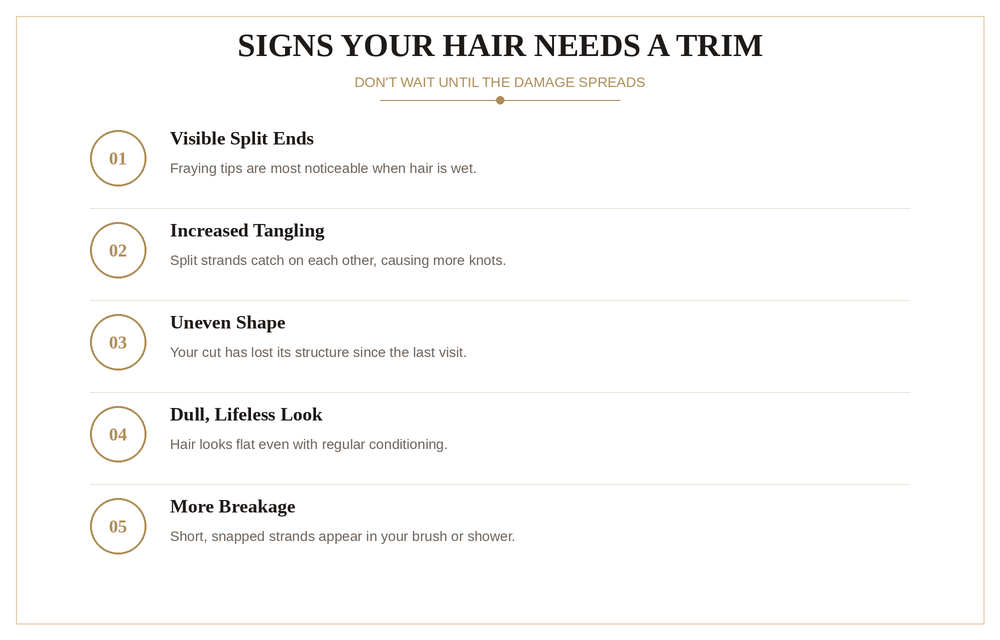
A proper split ends treatment at the salon involves precisely cutting above the damaged point, removing the fray entirely rather than just smoothing over it. Watch for these signs that you’re overdue: visible fraying when hair is wet, increased tangling, uneven shape, or hair that looks dull despite regular conditioning.
Hair Trimming Frequency vs Haircut Frequency: What’s Right for You?
There’s no single answer for how often to trim — the ideal hair trimming frequency depends on your hair type and goals. And if you’re due for a bigger style change rather than just maintenance, your haircut frequency will look a little different too:
| Hair Type / Goal | Trim Frequency | Full Haircut Frequency |
|---|---|---|
| Fine or fragile hair | Every 6–8 weeks | Every 3–4 months |
| Thick or coarse hair | Every 10–12 weeks | Every 4–6 months |
| Chemically treated or coloured hair | Every 6–8 weeks | Every 3–4 months |
| Growing hair out | Every 10–12 weeks (light dusting) | Rarely, unless reshaping |
| Maintaining a short style | Every 4–6 weeks | Every 4–6 weeks (trim and cut overlap) |
If you’re actively growing your hair out, it can feel counterproductive to trim regularly, but skipping trims for too long usually leads to more length loss from breakage than you’d lose from a small, consistent cut. A full haircut, on the other hand, is only needed when you want to reshape or change your style rather than simply maintain it.
Hair Breakage Prevention Beyond Trimming
While trims are essential, hair breakage prevention also depends on daily habits:
- Use a wide-tooth comb on wet hair to reduce snapping and pulling.
- Limit heat styling, or always apply a heat protectant beforehand.
- Avoid tight hairstyles that put constant tension on strands.
- Deep condition regularly to keep hair flexible rather than brittle.
- Protect hair while sleeping using a silk pillowcase or loose braid to reduce friction.
Combining these habits with regular hair trims gives you the best chance of maintaining long, healthy hair without constant breakage setbacks.
DIY Trims vs a Professional Salon Hair Trim
It might be tempting to trim your own ends at home, but a professional salon hair trim offers real advantages:
- Precision: Stylists use proper cutting techniques to remove damage without taking off more length than necessary.
- Even results: Professional trims maintain the shape and layers of your cut, which is difficult to replicate with household scissors.
- Better tools: Salon shears are sharper and designed specifically for hair, reducing further split ends from a dull blade.
DIY trims might save a visit occasionally, but for a cut that actually protects your length rather than damaging it further, professional precision makes a noticeable difference over time.
Common Myths About Hair Trimming
A few myths are worth clearing up:
- “Trimming makes hair grow faster.” Growth happens at the scalp — trims only prevent length loss from breakage.
- “Split end serums fix the problem permanently.” They only temporarily smooth the cuticle; the actual fix requires cutting off the damaged section.
- “Longer hair needs fewer trims.” Longer hair is actually more prone to dryness and breakage at the ends, since scalp oils take longer to travel down the length.
Understanding these myths helps set realistic expectations about what regular hair trims can and can’t do for your hair.
Visit Us: Hair Salon in Jakkur
Looking for a reliable hair salon in Jakkur to keep your ends healthy? At Scent Salon, our stylists don’t just trim on autopilot — every visit starts with a quick assessment of your hair’s condition, so you only lose the length that’s actually damaged. Our precision-cutting approach is designed to protect your length while still delivering clean, well-shaped results, whether you’re maintaining a short style or growing your hair out.
📅 Book Your Appointment
Conclusion
Regular hair trims aren’t just about maintaining a style — they’re one of the simplest, most effective ways to support healthy hair growth and prevent long-term damage. From reducing breakage to improving how your hair looks and feels day to day, the hair trim benefits add up quickly when done consistently.
Whether you’re maintaining a short style or growing your hair out, sticking to the right hair trimming frequency and choosing a professional salon hair trim over DIY scissors will keep your hair looking its healthiest.
FAQs
Does trimming hair actually make it grow faster?
No, trimming doesn’t affect growth at the scalp, but it prevents breakage that can offset growth, which often makes hair appear to grow longer and healthier over time.
How often should I get a hair trim?
It depends on your hair type, but most people benefit from a trim every 6–12 weeks, with fine or chemically treated hair needing more frequent visits.
What’s the difference between hair trimming frequency and haircut frequency?
Trimming frequency refers to small, regular maintenance cuts to remove damage, while haircut frequency refers to bigger style changes — most people need trims far more often than a full restyle.
Can split ends be repaired without cutting them?
No, split ends can only be temporarily smoothed with products — the only permanent fix is a proper split ends treatment that removes the damaged section.
Is it bad to skip trims while growing my hair out?
Skipping trims entirely often leads to more length loss from breakage than you’d lose from a small, regular trim, so light dusting every 10–12 weeks is usually recommended.
Is a professional trim really better than cutting my own hair at home?
Yes, professional stylists use precise techniques and sharper tools, resulting in more even, effective results compared to DIY trims at home.
Where can I book a professional hair trim near Jakkur, Bangalore?
Scent Salon in Jakkur offers professional hair trims, split ends treatment, and haircuts tailored to your hair type. You can book an appointment by phone, WhatsApp, or through our website.
Looking for more hair care tips? Explore our other blogs on hair fall solutions, deep conditioning treatments, and threading vs waxing.
Your skin faces pollution, sun exposure, stress, and long days of makeup and screen time — yet it’s often the last thing on the self-care list. A good Skin Care Treatment does more than offer a temporary glow; it actively works to cleanse, repair, and protect your skin from everyday damage.
In this guide, we’ll walk through the most effective treatments for glowing skin, including facial for glowing skin options, a simple face cleanup routine, and anti-ageing facial treatments for long-term skin health. We’ll also share practical glowing skin tips, point you to the best facial treatment for common concerns like acne treatment facial needs, and help you build a consistent skin care routine at home. If you’re nearby, we’ll point you to a trusted skin care salon in Jakkur where you can experience these treatments firsthand.
Table of Contents
- Why Professional Skin Care Matters
- Understanding Your Skin Type
- Face Cleanup: The Essential First Step
- Facials for Glowing Skin
- Anti-Ageing Facial Treatments
- Building a Skin Care Routine at Home
- How Often Should You Get a Facial?
- Common Skin Concerns and Which Treatment Helps
- Mistakes to Avoid With Skin Care Treatments
- Visit Us: Skin Care Salon in Jakkur
- Conclusion
- FAQs
Why Professional Skin Care Matters
Daily cleansing and moisturizing help maintain skin, but they can’t replicate what a professional skin care treatment does at a deeper level. Facials and cleanups use techniques like extraction, exfoliation, and targeted masks that reach layers of buildup and damage that at-home skin care routine steps simply can’t address.
Professional treatments also come with expert assessment — a trained esthetician can identify concerns like early signs of ageing, dehydration, or clogged pores before they become more visible or harder to treat. This is exactly why regular facial for glowing skin sessions, paired with a few simple glowing skin tips, are so often recommended over relying on products alone. Choosing the best facial treatment for your skin type makes all the difference in how quickly you see results.
Understanding Your Skin Type
Before choosing any skin care treatment, it helps to know your skin type, since this affects which products and techniques will work best:
- Oily skin: Prone to shine and clogged pores, often benefits from clay-based or deep-cleansing facial treatments, and may need an acne treatment facial if breakouts are frequent.
- Dry skin: Needs hydrating, nourishing treatments that avoid stripping natural oils.
- Combination skin: Requires balanced treatments that target oiliness in the T-zone while hydrating drier areas.
- Sensitive skin: Benefits from gentle, fragrance-free products and treatments with minimal chemical exposure.
A good skin care salon will always assess your skin type before recommending a specific facial for glowing skin, the best facial treatment for your concerns, or a broader treatment plan.
Face Cleanup: The Essential First Step
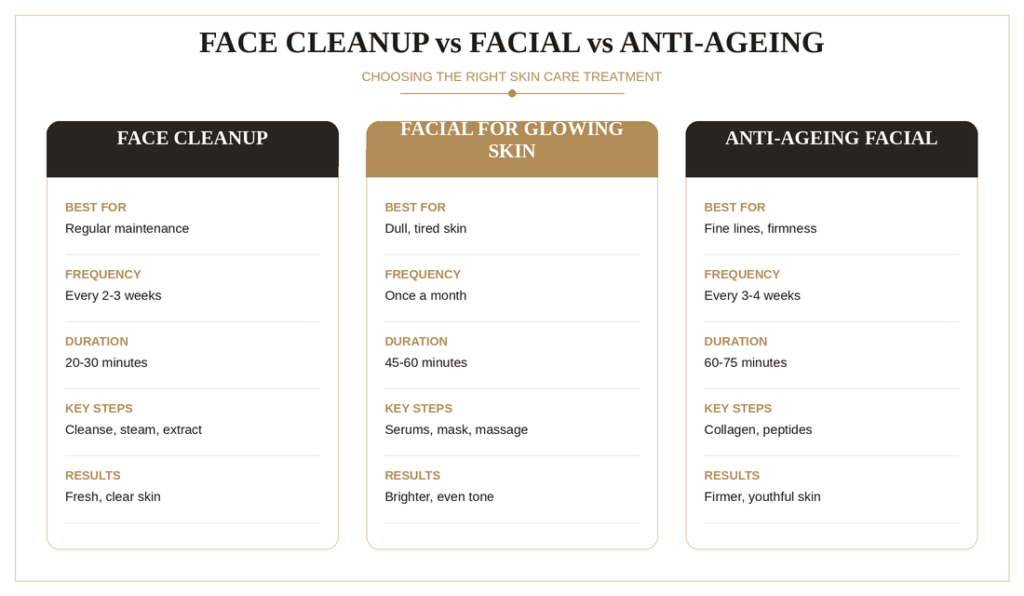
A face cleanup is one of the simplest yet most effective skin care treatments, ideal for regular maintenance between more intensive facials for glowing skin. It typically includes:
- Cleansing to remove surface dirt and makeup residue
- Steaming to open pores and loosen impurities
- Extraction to gently remove blackheads and whiteheads
- Scrubbing to exfoliate dead skin cells
- Mask application suited to your skin type
- Moisturizing and sun protection to finish the treatment
A face cleanup is quick, refreshing, and a great option before events or as part of a monthly skin care routine.
Facials for Glowing Skin
A facial for glowing skin goes a step further than a basic face cleanup, often incorporating specialized serums, massage techniques, and masks designed to brighten and even out skin tone. Common options include:
| Facial Type | Best For |
|---|---|
| Vitamin C Facial | Brightening dull skin and reducing dark spots |
| Hydrating Facial | Dry or dehydrated skin needing intense moisture |
| Detox Facial | Pollution-exposed skin needing deep cleansing |
| Gold or Radiance Facial | Special-occasion glow and skin brightening |
These facial treatments typically involve a longer massage component, which also helps improve blood circulation and gives skin a naturally lifted, refreshed appearance — one of the main reasons a facial for glowing skin remains one of the most requested skin care treatment options at any salon. If you’re comparing options, ask your esthetician which is the best facial treatment for your specific skin goals.
Anti-Ageing Facial Treatments
As skin matures, it loses collagen and elasticity, leading to fine lines and a duller complexion. An anti-ageing facial addresses these concerns using ingredients and techniques such as:
- Collagen-boosting serums to improve firmness over time
- Peptide-infused masks that support skin repair
- Facial massage techniques to improve circulation and muscle tone
- Antioxidant treatments to protect against further environmental damage
While no facial can fully reverse ageing, regular anti-ageing facial treatments can noticeably improve skin texture, firmness, and radiance over time — making this one of the most valuable long-term skin care treatment investments you can make.
Building a Skin Care Routine at Home
Between professional skin care treatment sessions, a consistent skin care routine helps maintain and extend your results:
- Cleanse twice daily with a gentle, skin-type-appropriate cleanser.
- Moisturize consistently, even if your skin feels oily, to maintain a healthy skin barrier.
- Never skip sunscreen, since UV exposure is one of the leading causes of premature ageing.
- Exfoliate weekly, not daily, to avoid over-stripping the skin.
- Stay hydrated and eat well, since skin health is closely tied to overall nutrition and hydration levels.
- Avoid touching your face frequently, which can transfer bacteria and worsen breakouts.
These simple glowing skin tips, combined with a good skin care routine at home and periodic facial for glowing skin sessions, are the most effective way to maintain healthy, glowing skin long-term.
How Often Should You Get a Facial?
The right frequency depends on your skin type and goals:
- Face cleanup: Every 2–3 weeks for regular maintenance.
- Facial for glowing skin: Once a month, or before special occasions.
- Anti-ageing facial: Every 3–4 weeks for visible, consistent improvement.
- Sensitive skin: Space treatments slightly further apart to avoid irritation, and always request patch tests for new products.
If you’re unsure where to start, a consultation with a skin care professional can help you build a realistic, effective treatment schedule.
Common Skin Concerns and Which Treatment Helps
Different skin concerns call for different skin care treatment approaches. Here’s a quick guide to matching your concern with the right facial for glowing skin or targeted treatment:
- Dull, tired-looking skin: A Vitamin C or radiance facial helps brighten tone and restore a healthy glow.
- Clogged pores and blackheads: A face cleanup with proper extraction is usually the most effective starting point.
- Fine lines and loss of firmness: An anti-ageing facial with collagen-boosting ingredients addresses this most directly.
- Dehydrated, flaky skin: A hydrating facial with intensive moisture masks helps restore the skin barrier.
- Uneven skin tone or pigmentation: Treatments with brightening actives, combined with consistent sunscreen use, show the best long-term results.
- Acne and breakouts: An acne treatment facial with anti-bacterial and calming ingredients helps manage flare-ups without over-drying skin.
- Sensitive, reactive skin: Gentle, fragrance-free facials with calming ingredients like aloe vera or chamomile are usually the safest choice.
Matching the treatment to the actual concern — rather than choosing based on trends — is what leads to visible, lasting improvement in your overall skin care routine.
Mistakes to Avoid With Skin Care Treatments
Even well-intentioned skin care routine habits can sometimes backfire. Watch out for these common mistakes:
- Over-exfoliating: Too much scrubbing or chemical exfoliation can damage the skin barrier and cause irritation or breakouts.
- Skipping patch tests: Especially important before trying a new facial or product, to avoid unexpected allergic reactions.
- Picking at extractions at home: This increases the risk of scarring and infection — leave extractions to trained professionals during your face cleanup.
- Using the wrong products for your skin type: A rich cream meant for dry skin can worsen oiliness and breakouts if used on oily skin, and vice versa.
- Ignoring sunscreen after treatments: Skin is often more sensitive after a facial for glowing skin or cleanup, making sun protection even more essential immediately afterward.
- Expecting instant, permanent results: Skin care is cumulative — a consistent skin care treatment plan over time delivers far better results than a single session.
Avoiding these mistakes helps you get the most out of both professional treatments and your at-home skin care routine.
Visit Us: Skin Care Salon in Jakkur
Looking for a reliable skin care salon in Jakkur? At Scent Salon, our skin care treatments are tailored to your skin type, from quick face cleanups to specialized anti-ageing facials, acne treatment facial sessions, and facials for glowing skin. Our estheticians take the time to assess your skin before recommending the best facial treatment, ensuring you get results that actually match your skin’s needs.
📅 Book Your Appointment
Conclusion
Healthy, glowing skin rarely happens by accident — it’s the result of understanding your skin type and following through with the right combination of professional skin care treatment and home care. Whether you need a quick face cleanup, a brightening facial for glowing skin, an acne treatment facial, or a more targeted anti-ageing facial, consistency is what delivers real, lasting results.
If you’re unsure where to start, a professional consultation at a trusted skin care salon in Jakkur can help you find the best facial treatment for your needs and build a skin care routine — backed by simple glowing skin tips — that actually works for your specific skin, rather than following generic advice that may not apply to you.
FAQs
What is the difference between a face cleanup and a facial?
A face cleanup focuses on cleansing, extraction, and basic exfoliation, while a facial includes additional steps like specialized masks and massage for deeper, more targeted results.
How often should I get a facial for glowing skin?
Once a month is generally sufficient for most skin types, though it can be done more frequently before special occasions.
At what age should I start anti-ageing facials?
Most estheticians recommend starting preventive anti-ageing treatments in your mid-to-late twenties, though it varies based on skin type and lifestyle factors.
Can I do a face cleanup if I have sensitive skin?
Yes, but it’s important to inform your esthetician beforehand so they can adjust products and techniques to avoid irritation.
Do facials help with acne-prone skin?
Yes, an acne treatment facial with deep-cleansing and anti-bacterial ingredients can help manage acne, though it’s best to consult a professional for persistent or severe acne.
How soon will I see results from a facial?
Many people notice brighter, smoother skin immediately after a single session, with more significant improvements after 3–4 regular treatments.
Where can I book a professional skin care salon near Jakkur, Bangalore?
Scent Salon in Jakkur offers a full range of skin care treatments, including face cleanups, glow facials, and anti-ageing treatments. You can book an appointment by phone, WhatsApp, or through our website.
Looking for more beauty care tips? Explore our other blogs on hair fall solutions, threading vs waxing, and deep conditioning treatments.
Bangalore has no shortage of salons, but not every Hair Salon in Bangalore delivers the same standard of hygiene, expertise, or results. Whether you’re after a simple hair cut or a full transformation, knowing what to look for before booking can save you from a disappointing experience — or worse, damaged hair.
In this guide, we’ll walk through exactly what separates an average salon from a true Luxury Salon experience, covering everything from Hair Styling and hair spa to hair colouring, hair treatment, and beard styling. If you’re in the area, we’ll also point you to a trusted Hair Salon in Jakkur where you can experience premium care firsthand.
Table of Contents
- Why the Right Salon Matters
- Hygiene and Sanitation Standards
- Stylist Expertise and Training
- Range of Services Offered
- Quality of Products Used
- Ambience and Overall Experience
- Questions to Ask Before Booking
- Red Flags to Watch Out For
- Cost vs Value: What You’re Really Paying For
- Visit Us: Premium Hair Salon in Jakkur
- Conclusion
- FAQs
Why the Right Salon Matters
A haircut or colour job isn’t just a cosmetic choice — it involves chemicals, sharp tools, and techniques that directly affect the health of your hair and scalp. Choosing the wrong salon can mean uneven results, damaged hair from poor technique, or even skin reactions from low-quality products.
A premium salon experience isn’t about luxury for its own sake — it reflects genuinely better training, better products, and better attention to detail, all of which affect how your hair looks and feels long after you leave the chair.
Hygiene and Sanitation Standards
Before booking anywhere, hygiene should be non-negotiable. Look for:
- Sanitized tools: Scissors, combs, and razors should be sterilized or disposable between clients.
- Clean workstations: Chairs, mirrors, and counters should be wiped down regularly throughout the day.
- Fresh towels and capes: Reused, unwashed towels are a red flag for any salon, regardless of how upscale it looks.
- Proper ventilation: Especially important for services involving chemical treatments like hair colouring or keratin.
A salon that takes hygiene seriously will usually be transparent about its sanitation practices if you ask.
Stylist Expertise and Training
Even the best products can’t compensate for poor technique. Before booking, consider:
- Certifications and training: Ask whether stylists are certified in specific techniques, especially for complex services like colour correction or beard styling.
- Portfolio or past work: Many salons showcase client transformations on social media — this can give you a good sense of consistency and skill level.
- Specialization: Some stylists specialize in specific services, so ask if someone with relevant experience is available for your needs.
- Consultation quality: A good stylist will ask detailed questions about your hair history, lifestyle, and expectations before recommending a service.
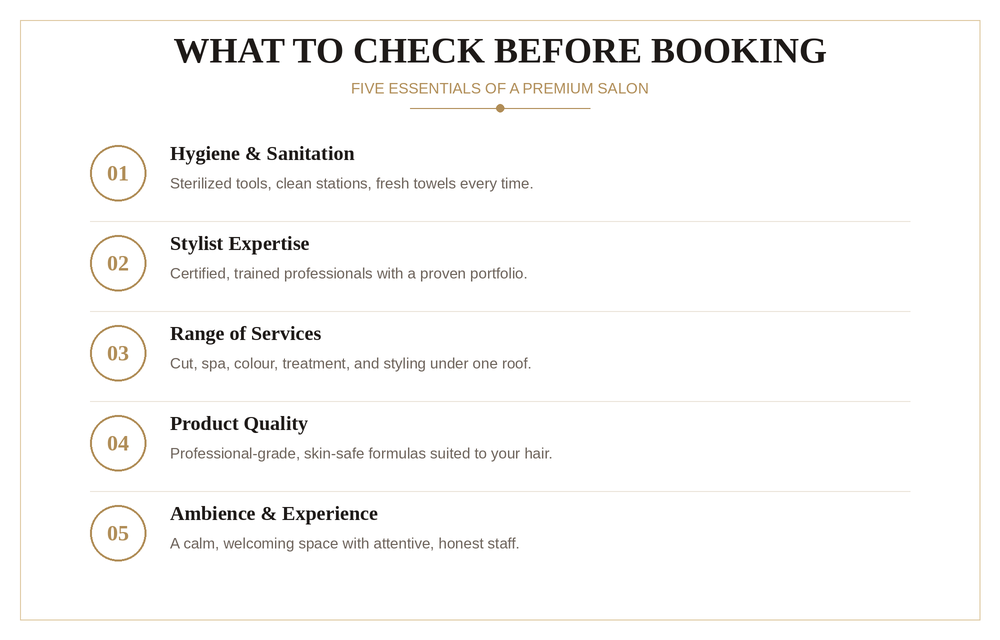
Range of Services Offered
A well-rounded, premium salon typically offers a full suite of services under one roof, including:
| Service | What It Covers |
|---|---|
| Hair Cut | Precision cutting, layering, and styling consultations |
| Hair Spa | Deep conditioning and scalp therapy for dry or damaged hair |
| Hair Colouring | Global colour, highlights, balayage, and colour correction |
| Hair Treatment | Smoothing, and repair treatments for specific concerns |
| Beard Styling | Shaping, trimming, and grooming for a polished finish |
| Hair Styling | Blow-dry, updos, and event-ready looks |
Having access to multiple services in one place isn’t just convenient — it also means your stylist has a complete picture of your hair’s history, which leads to better, more consistent results over time.
Quality of Products Used
Premium salons invest in professional-grade products rather than generic, mass-market alternatives. When evaluating a salon, ask:
- What brands do they use for colouring and treatments?
- Are products suited to different hair types (curly, chemically treated, colour-treated)?
- Do they offer patch tests before colour services, especially for first-time clients?
- Are aftercare products (like sulfate-free shampoos) recommended and available for purchase?
Higher-quality products often mean less scalp irritation, longer-lasting colour, and healthier-looking hair after treatments.
Ambience and Overall Experience
While hygiene and skill matter most, ambience does affect the overall experience — especially for relaxation-focused services like hair spa or beard styling. Look for:
- A clean, well-organized space that feels calm rather than rushed
- Comfortable seating and appropriate lighting for both cuts and colour work
- Friendly, professional staff who make you feel comfortable asking questions
- Reasonable wait times and respect for your appointment schedule
A great ambience won’t fix poor technique, but it does add real value to a premium salon visit.
Questions to Ask Before Booking
Before committing to a new salon, it’s worth asking a few direct questions:
- “Can I see examples of your previous colour or styling work?”
- “What products do you use for chemical treatments?”
- “Do you offer a consultation before major services like colouring or treatments?”
- “How do you sanitize your tools between clients?”
- “Do you have stylists experienced with my specific hair type or concern?”
A confident, transparent answer to these questions is usually a good sign you’re in capable hands.
Red Flags to Watch Out For
Just as there are signs of a great salon, there are also warning signs worth paying attention to:
- Reluctance to answer questions: If a salon seems evasive about products, pricing, or hygiene practices, that’s worth noting.
- No patch test offered before colour services: This is a basic safety step that reputable salons rarely skip.
- Rushed consultations: A stylist who doesn’t ask about your hair history or goals before starting a service may not be paying close enough attention to detail.
- Visibly worn-out or unclean tools: Chipped, rusty, or dirty tools are a clear hygiene concern.
- Pressure to add unnecessary services: Constant upselling during your appointment can be a sign the salon prioritizes revenue over your actual needs.
- Inconsistent pricing: Prices that change significantly without clear explanation can indicate a lack of transparency.
Trusting your instincts matters here — if something feels off during your first visit, it’s okay to look elsewhere for your next appointment.
Cost vs Value: What You’re Really Paying For
Premium pricing at a salon isn’t always about luxury branding — often, it reflects real differences in what you’re getting:
- Trained stylists who’ve invested time and money into certifications and skill development
- Higher-grade products that are gentler on hair and scalp, reducing long-term damage
- Better hygiene protocols, including sterilized tools and clean, sanitized workstations
- More accurate consultations, reducing the risk of a botched cut or colour job
- Longer-lasting results, meaning fewer touch-ups and potentially lower costs over time
When comparing salons purely on price, it’s worth factoring in these hidden costs of a cheaper, lower-quality experience — from redone colour jobs to damaged hair that takes months to repair.
Visit Us: Premium Hair Salon in Jakkur
Looking for a reliable hair salon in Jakkur that checks all these boxes? At Scent Salon, we offer a complete range of services — from precision hair cut and hair spa to hair colouring, hair treatment, and beard styling — all delivered with trained stylists, premium products, and a calm, welcoming space.
📅 Book Your Appointment
Conclusion
Choosing a premium hair salon isn’t about picking the most expensive option — it’s about finding one that takes hygiene, stylist expertise, and product quality seriously. Whether you’re booking a simple hair cut or a more involved hair treatment, asking the right questions upfront can save you time, money, and disappointment down the line.
If you’re in the area, a quick visit to check the space and speak with the team can tell you a lot before you even sit down for your first service.
FAQs
What should I look for in a good hair salon?
Focus on hygiene practices, stylist training and certifications, the range of services offered, and the quality of products used for treatments and colouring.
How do I know if a salon uses good quality products?
Ask directly about the brands they use, whether they offer patch tests before colour services, and if they recommend suitable aftercare products for your hair type.
Is it important for a salon to offer multiple services?
Yes, having services like hair cut, hair spa, and hair colouring under one roof means your stylist understands your hair’s full history, leading to better long-term results.
Should I ask for a consultation before a haircut or colour service?
Absolutely. A good salon will always offer a consultation to understand your hair history, goals, and any concerns before starting a service.
How can I check if a salon’s hygiene standards are good?
Look for sanitized tools, clean workstations, fresh towels, and proper ventilation, especially during chemical treatments like colouring or smoothing services.
Are premium salons worth the extra cost?
Often yes, since they typically use better products, employ trained stylists, and maintain higher hygiene standards, all of which affect the health and appearance of your hair long-term.
Where can I find a premium hair salon near Jakkur, Bangalore?
Scent Salon in Jakkur offers a full range of premium hair services, including hair cut, hair spa, hair colouring, hair treatment, and beard styling. You can book an appointment by phone, WhatsApp, or through our website.
Looking for more salon tips? Explore our other blogs on hair fall solutions, Facial Services, and deep conditioning treatments.
Your hands and feet go through a lot every day, yet nail care is often the first thing to slip down the self-care list. Regular Manicure and Pedicure sessions do more than just make your nails look polished — they play a real role in hygiene, skin health, and even early detection of certain health issues.
In this guide, we’ll cover why consistent Nail Care matters, how it supports long-term Nail Health, and what to expect from Organic Manicure and Organic Pedicure treatments if you prefer gentler, chemical-free options.
Table of Contents
- What Happens During a Manicure and Pedicure?
- Key Benefits for Nail Health
- Manicure vs Pedicure: What’s the Difference?
- Why Choose Organic Manicure and Organic Pedicure?
- Signs Your Nails Need Professional Care
- Building a Nail Care Routine Between Salon Visits
- How Often Should You Get a Manicure and Pedicure?
- Common Nail Care Mistakes to Avoid
- Choosing the Right Nail Salon
- Visit Us: Nail Salon in Jakkur
- Conclusion
- FAQs
What Happens During a Manicure and Pedicure?
A professional manicure typically includes nail shaping, cuticle care, hand exfoliation, moisturizing massage, and polish application. A pedicure follows a similar process for the feet, often with additional focus on calluses, foot soaking, and heel care.
Beyond the cosmetic result, both treatments involve close inspection of the nails and surrounding skin, which means a good technician can often spot early signs of dryness, fungal issues, or ingrown nails before they become bigger problems.
Key Benefits for Nail Health
Regular manicure and pedicure sessions offer benefits that go well beyond appearance:
- Improved circulation: The massage component of both treatments stimulates blood flow to the hands and feet, which can reduce stiffness and promote healthier nail growth.
- Reduced risk of infections: Proper cuticle care and sanitized tools lower the chances of bacterial or fungal infections compared to at-home DIY methods.
- Stronger, less brittle nails: Regular moisturizing and buffing help prevent peeling, cracking, and splitting over time.
- Early detection of issues: Technicians often notice early signs of ingrown nails, dryness, or skin conditions during routine sessions.
- Softer skin: Exfoliation and moisturizing treatments keep the skin around nails smooth and prevent painful cracking, especially on heels.
- Mental relaxation: The massage and pampering aspect of these treatments also offers a real stress-relief benefit, not just a cosmetic one.
Manicure vs Pedicure: What’s the Difference?
While both treatments follow a similar structure, there are a few key differences worth knowing:
| Factor | Manicure | Pedicure |
|---|---|---|
| Focus area | Hands and nails | Feet and toenails |
| Common add-ons | Cuticle oil, hand massage | Foot soak, callus removal |
| Frequency | Every 2–3 weeks | Every 3–4 weeks |
| Skin focus | Softening hands | Heel and sole care |
| Common concerns | Brittle nails, dry cuticles | Calluses, cracked heels |
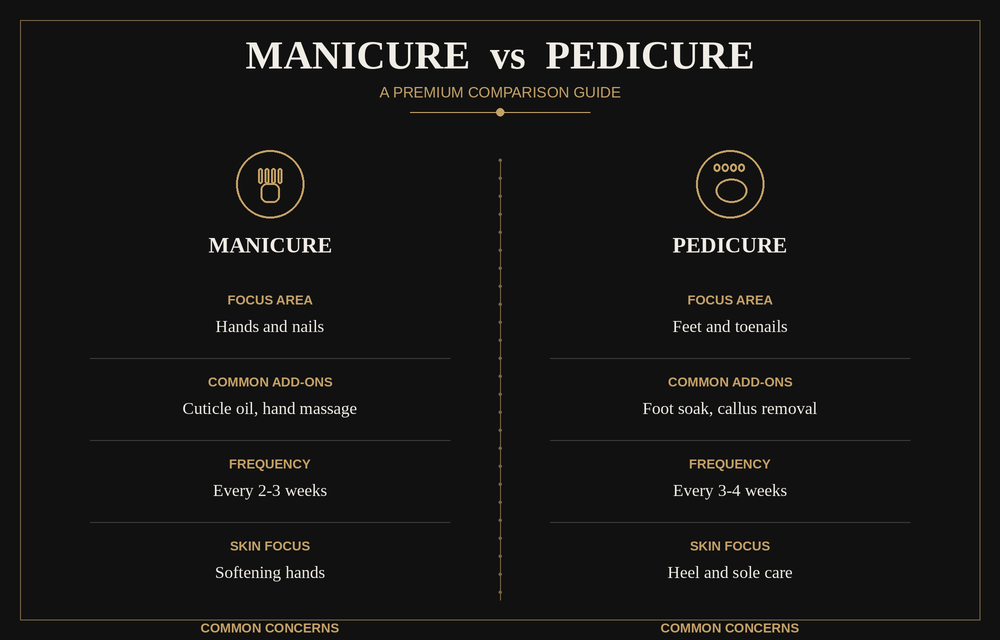
Why Choose Organic Manicure and Organic Pedicure?
If you’re sensitive to strong chemicals or simply prefer a more natural approach, organic treatments are worth considering. An organic manicure typically uses plant-based oils, natural exfoliants, and non-toxic, formaldehyde-free polishes instead of harsh synthetic products.
Similarly, an organic pedicure swaps out chemical-heavy foot soaks for natural ingredients like sea salt, essential oils, and herbal extracts, which are gentler on sensitive skin while still delivering effective exfoliation and hydration.
Benefits of going organic include:
- Reduced risk of skin irritation or allergic reactions
- A more natural, lightly scented spa experience
- Better suited for people with sensitive skin or nail conditions
- Environmentally friendlier ingredients and packaging in most cases
If you’ve experienced redness or irritation after regular treatments in the past, it may be worth switching to organic manicure and organic pedicure options at your next visit.
Signs Your Nails Need Professional Care
Not sure if it’s time to book an appointment? Watch for these signs:
- Cuticles that are overgrown, dry, or frequently peeling
- Nails that split, crack, or break easily
- Rough, cracked heels or persistent calluses
- Discoloration or thickening of the nails
- Ingrown toenails causing discomfort
- Nails that grow unevenly or slower than usual
If you notice several of these signs, a professional manicure and pedicure session can help address the root cause rather than just masking it with polish.
Building a Nail Care Routine Between Salon Visits
To maintain results between appointments, a simple at-home routine goes a long way:
- Moisturize daily: Apply hand cream and foot cream regularly, especially after washing.
- Avoid harsh soaps: Strong detergents can dry out cuticles and weaken nails over time.
- Wear gloves for chores: Protect your hands during cleaning or dishwashing to prevent dryness and damage.
- Trim nails properly: Cut nails straight across to reduce the risk of ingrown nails, especially on toes.
- Use cuticle oil: A few drops a day keeps cuticles soft and prevents painful cracking.
- Don’t skip sunscreen on hands: UV exposure can age skin and weaken nails over time, just like it does with facial skin.
Combining this simple routine with regular professional treatments keeps your nail health consistent all year round.
How Often Should You Get a Manicure and Pedicure?
The right frequency depends on your lifestyle and nail growth rate:
- Manicure: Every 2–3 weeks is ideal for maintaining shape and cuticle health.
- Pedicure: Every 3–4 weeks works well for most people, though those with active lifestyles may need more frequent visits.
- Organic manicure and pedicure: The same frequency applies, though some people alternate between organic and regular treatments based on skin sensitivity or occasion.
Sticking to a consistent schedule not only keeps your nails looking their best but also makes it easier to catch small issues before they become bigger problems.
Common Nail Care Mistakes to Avoid
Even well-intentioned nail care habits can sometimes do more harm than good. Watch out for these common mistakes:
- Cutting cuticles too aggressively: Cuticles protect the nail bed from bacteria, so trimming them too short can increase infection risk.
- Peeling off polish or gel: This often takes layers of the nail with it, leaving nails thin and prone to breakage.
- Skipping the base coat: Applying polish directly on nails can cause staining and weaken the nail surface over time.
- Ignoring foot care in winter: Cold weather can worsen dryness and cracked heels, so pedicure routines shouldn’t be paused seasonally.
- Using expired or shared tools: Old or unsanitized nail tools increase the risk of fungal infections — always check that your salon sterilizes equipment between clients.
- Not moisturizing after washing hands: Frequent hand washing without follow-up moisturizing is one of the most common causes of dry, brittle nails.
Avoiding these habits, combined with regular professional care, keeps your nails and skin in noticeably better condition.
Choosing the Right Nail Salon
Not all nail salons offer the same standard of hygiene or expertise, so it’s worth knowing what to look for before booking:
- Visible sanitation practices: Tools should be sterilized or disposable, and workstations should be cleaned between each client.
- Trained technicians: Ask about training and experience, especially if you’re booking specialized services like organic manicure and organic pedicure treatments.
- Quality products: Reputable salons use well-known, skin-safe polish and treatment brands rather than unbranded or questionable products.
- Clear service menus: A good salon will clearly explain what’s included in each treatment, so there are no surprises with pricing or add-ons.
- Positive reviews and reputation: Genuine customer reviews often reveal a lot about consistency, hygiene, and customer service quality.
Taking a few minutes to check these factors before booking can make a real difference in both your results and your overall experience.
Visit Us: Nail Salon in Lavelle Road
Looking for a reliable nail salon in Jakkur? At Scent Salon, we offer both classic and organic manicure and pedicure treatments, tailored to your skin type and nail health needs. Whether you’re after a quick nail care refresh or a fully organic spa experience, our trained technicians ensure a relaxing, hygienic session every time.
Conclusion
Healthy nails are about more than polish — they reflect how well your hands and feet are actually being cared for. Regular manicure and pedicure sessions improve circulation, prevent infections, and catch small issues before they turn into bigger problems, all while giving you a well-deserved moment of relaxation.
Whether you choose classic treatments or prefer the gentler approach of organic manicure and organic pedicure options, consistency is what delivers real, lasting nail health — not a one-time visit.
📅 Book Your Appointment
FAQs
How often should I get a manicure and pedicure?
Most people benefit from a manicure every 2–3 weeks and a pedicure every 3–4 weeks, depending on nail growth and lifestyle.
What is the difference between a regular and an organic manicure?
An organic manicure uses plant-based oils, natural exfoliants, and non-toxic polishes instead of synthetic chemicals, making it gentler for sensitive skin.
Can a pedicure help with cracked heels?
Yes, professional pedicures include exfoliation and moisturizing treatments specifically designed to soften calluses and repair cracked heels over time.
Is organic pedicure suitable for sensitive skin?
Yes, organic pedicures are especially recommended for sensitive skin since they avoid harsh chemicals that can cause irritation or allergic reactions.
Do manicures and pedicures help prevent nail infections?
Yes, proper cuticle care and sanitized tools significantly reduce the risk of bacterial or fungal infections compared to at-home nail care.
Can I get a manicure and pedicure done together in one visit?
Yes, most salons offer combo packages that let you complete both treatments in a single, relaxing session.
Where can I book a professional nail salon near Jakkur Road?
Scent Salon on Jakkur offers professional manicure, pedicure, and organic nail care services. You can book an appointment by phone, WhatsApp, or through our website.
Looking for more beauty care tips? Explore our other blogs on hair fall solutions, threading vs waxing, and deep conditioning treatments.